



The citrus-based liquid that stores cold
16th November 2026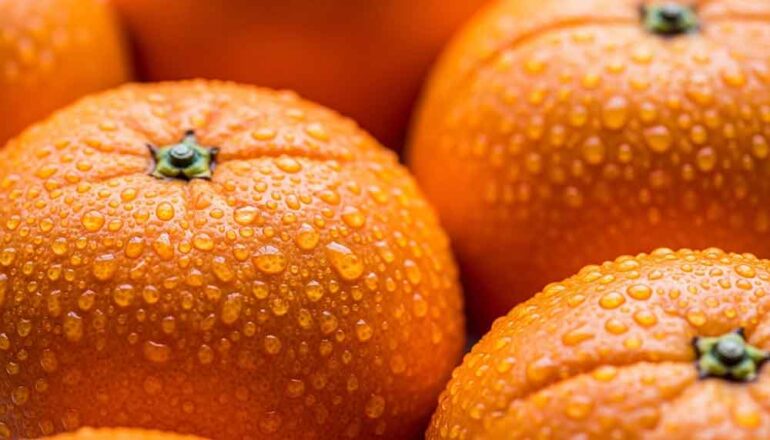
SPAIN: A university research team is developing a liquid from citrus peels that can store and release cold based on temperature changes, improving the efficiency of refrigeration systems.
A research team from the Research Centre for Chemical Product and Process Technology (Pro2TecS) at the University of Huelva (UHU), in collaboration with the Department of Chemical Engineering at the University of Seville (US), has used citrus peels such as lemon, orange, and grapefruit in a liquid that functions as a cold storage medium.
According to the research team, it is an option for processes that need to maintain a stable and efficient cold, such as industrial freezing, preservation and transport of food, medicines or biological samples, as well as in very low temperature refrigeration systems.
The emulsion contains no water, allowing it to operate at temperatures far lower than some conventional secondary refrigerants, such as glycol-water mixtures or brines commonly used in refrigeration systems.
Tests are said to have shown that the solution operates in a range of approximately -85ºC to +5ºC. It was also shown to be able to store and transport up to 2.4 times more cold, occupying the same space as some common refrigerants. It will need to be validated under real-world conditions before becoming a final product.
It could function by circulating through pipes or heat exchangers, as other refrigerants do, or by acting as a thermal accumulator, similar to an ice pack.
This emulsion combines two liquids – polyethylene glycol and the citrus solution – that do not mix naturally, and adds a third element, silica nanoparticles, to keep the compound stable.
The polyethylene glycol PEG400 acts as a cooling reservoir, absorbing and releasing energy when changing state. Then, D-limonene, derived from citrus peel, is added, replacing water and allowing operation at very low temperatures. Finally, silica nanoparticles act as a kind of microscopic “glue”, keeping the droplets of the cold-storing material separate and preventing them from coalescing when the mixture freezes and thaws.
Adding too much silica makes the liquid more viscous and harder to move through pipes, so the challenge lies in fine-tuning the mixture.
This work represents a first phase of research. So far, the team has formulated the material, studied its thermal and flow properties, and compared its performance with common refrigerants through laboratory tests and mathematical calculations.
The next steps focus on testing the emulsion in systems more closely resembling a facility with compressors, valves, pipes, and heat exchangers . This will allow researchers to verify whether the results hold true under real-world conditions and whether the formulation needs adjusting.