


Air pollutants removed by refrigeration
9th November 2018
UK: Scientists have discovered that refrigeration can be employed to remove outdoor air pollutants.
The international study, involving the UK’s Nottingham Trent University and the Chinese Academy of Sciences, could pave the way for simple modification of air conditioning and humidifier units so that they can have the option to clean polluted indoor air.
The research, led by Nottingham Trent University’s Professor Gang Pan, involved studying the effectiveness of cryogenics for indoor air purification, by removing the gaseous pollutants and tiny particulates caused by haze.
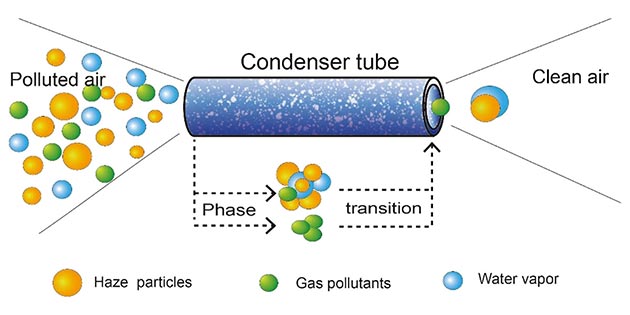
The team found that as they circulated haze-polluted air through a cryogenic condenser, the finer particles stuck together in the condenser tube before dropping out by gravity, and emerging as clean air. Their method was able to remove 99% of particulates.
It was also found that 98% of NO2 could be condensed and removed from the ambient air at -50 °C, implying that the method would be effective for multiple indoor pollutants with higher boiling points. The developers say that cryogenic condensation may provide a principle for continuous indoor air purification via modified air conditioners and humidifiers in cases where health benefits outweigh energy consumption concerns.
“Hazardous outdoor air pollution has severely affected indoor air quality, threatening the health of billions of people,” said Professor Robert Mortimer, a researcher on the study and Dean of the School of Animal, Rural and Environmental Sciences at Nottingham Trent University.
He said: “Outdoor air pollution in cities is a global problem, whether it be haze plaguing Beijing or poor air impacting the health of children in inner city London schools. While there are some existing technologies to purify indoor air, they can be inefficient, expensive or produce harmful by-products.
“When outdoor air quality is poor, people tend to spend even more time indoors – but outdoor pollution also leads to indoor pollution and people are still impacted.”
Professor Gang Pan added: “We have shown in our experiments that simply by circulating polluted air through a small freezing chamber we can remove most of fine particles and gas pollutants.
“Our study makes it possible to add an ‘air cleaner’ option to household appliances in areas which might experience extremely poor air conditions. By controlling indoor air pollution and improving air quality in this way, this work could be greatly beneficial for public health.”
The study is reported in the journal Science of the Total Environment.