


CO2 Conveni-Pack has better LCCP but lower efficiency
2nd October 2023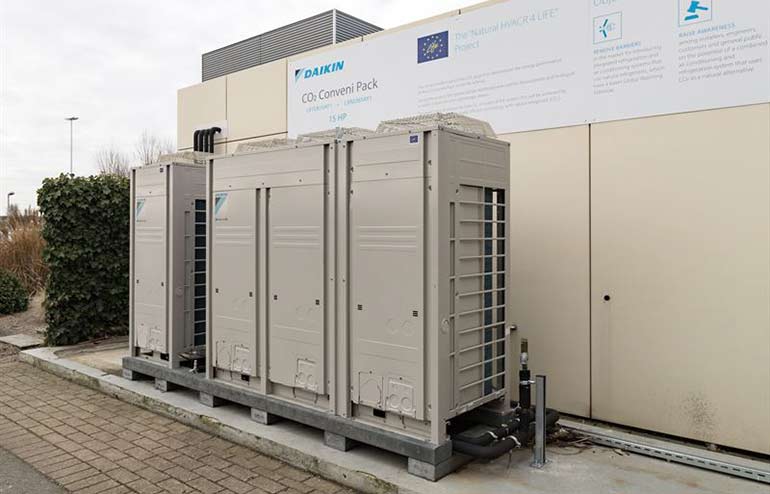
BELGIUM: Tests on an optimised CO2 version of Daikin’s Conveni-Pack refrigeration system is said to have shown 21% lower life cycle emissions compared to traditional R410A.
The tests were carried out under the €5m HVACR 4 LIFE research project, which ran from 2019 to 2023. It was led by a team of research engineers at Daikin Europe and explored the use of CO2 as refrigerant in an integrated refrigeration, comfort cooling and heating solution with thermal storage.
The GWP of CO2 was said to be the major differentiator between it and the R410A unit. While the CO2 emissions linked to the materials used in the units were higher for the CO2 unit (since the unit is twice the size of the R410A one) and the CO2 unit consumed more energy, the CO2 unit revealed 21% lower life cycle emissions over a 10-year life cycle.
Daikin reports that the R410A unit performs notably better and is 13% more energy efficient.
Combination
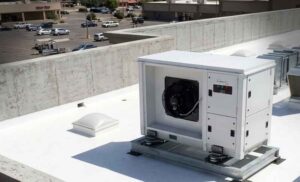
Available in Japan since early 2000 and introduced into Europe in 2006, Daikin’s Conveni-Pack combines freezing, refrigeration and energy efficient heat pump air conditioning technology for forecourts and convenience stores.
It recovers heat from the refrigeration display cabinets and reuses this heat for space heating. In this way, around 38% of the annual space heating demand for a typical supermarket can be reclaimed.
Optimised
The research project developed an optimised indoor air distribution cassette for the system with CO2 refrigerant and tested the thermal storage system’s performance under different climate conditions. Systems were installed and monitored at selected supermarket locations in Germany, France, Spain, Czech Republic and Belgium.
The new unit adopted a new Daikin swing compressor, specially designed for CO2 refrigerant and used BLDC inverter motors and two-stage compression.
The team also adapted the CO2 Conveni-pack to connect with a thermal energy storage module. An economically-viable cassette indoor unit to go with the system was also developed.
Following the research, Daikin insists that selection of type of system depends on the needs per application. Because of the differences in performance on distinct aspects, Daikin says it commercialises both R410A and CO2 systems.
“We are grateful to have been part of this EU Life project. It clearly highlighted the benefits of CO2 as a natural refrigerant in integrated HVACR systems,” said Junji Umamoto, Daikin Europe’s vice-president cold chain.
Related stories:
Daikin CO2 Conveni-Pack uses new swing compressor – 23 February 2020
GERMANY: Daikin used last week’s Euroshop exhibition to present its recently announced Conveni-Pack commercial refrigeration system using CO2 refrigerant. Read more…
Daikin to test viability of CO2 Conveni-Pack – 21 January 2020
BELGIUM: Daikin is looking to demonstrate the viability of a CO2 version of its established Conveni-Pack integrated supermarket refrigeration and comfort cooling and heating system. Read more…