


Danfoss ejector boosts CO2 refrigeration
20th May 2026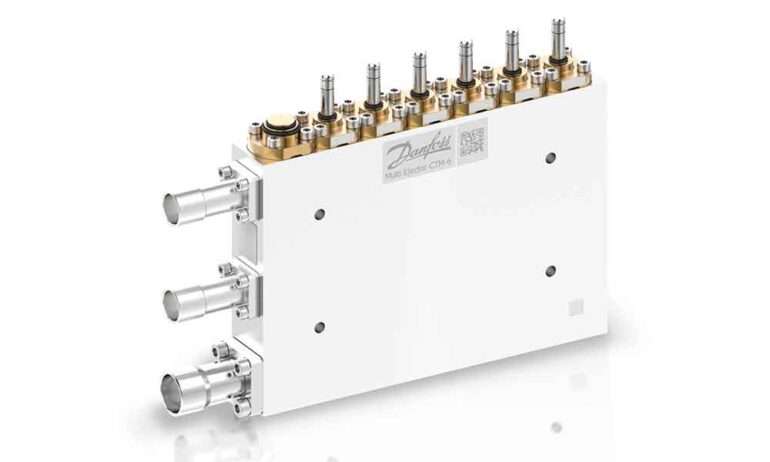
DENMARK: Tests using Danfoss’ multi ejector high pressure (HP) technology in a transcritical CO2 booster system are said to have shown 21% energy savings over traditional CO2 booster systems.
While CO2 refrigeration offers a sustainable alternative to HFC/HFO refrigerants, Danfoss maintains that achieving energy efficiency at high ambient temperatures is a challenge.
In a traditional transcritical CO2 booster system, energy is often wasted as highly pressurised CO2 fluid is created in the compression cycle and pumped through the system, resulting in the rejection of its excess heat. Danfoss says that utilising parallel compression and ejector technology can harness this potential energy, reducing overall energy consumption and compressor workload.
Danfoss engineers installed the multi ejector HP in a Hussmann transcritical CO2 booster system using parallel compression. Also installed was a Danfoss pack controller, to manage variable pressures in the receiver and to control rack operation, valve logic, and ejector staging, thereby ensuring optimal performance under all conditions. The entire system was installed in two new supermarkets, one in a mild climate and one in a warm climate, and tested with the ejector both on and off.
At ambient temperatures of 95ºF, using the ejector is said to have resulted in actual incremental energy savings up to 13.4% versus using parallel compression alone. The total energy savings over a traditional booster system was said to be 21%.
With the ejector on, compressor cycling was also reduced with 43-47% reduction in on/off cycles, which reduced cumulative inrush current and mechanical wear.
Details of how Danfoss’ multi ejector HP, in conjunction with parallel compression, can result in significant energy savings, particularly in warm climates is documented in a new whitepaper.