


Dimethyl ether and blends improve efficiency
27th May 2025SPAIN: New research has found that dimethyl ether (RE170) and ternary mixtures of the same refrigerant with CO2 and butane could improve the energy efficiency of vapour compression systems.
A thermodynamic analysis and experimental evaluation by researchers at Spain’s Jaume I University indicate that RE170 and its mixtures provide superior energy efficiency compared to R290, albeit with reduced cooling and heating capacities.
Flammable RE170, with its GWP of 1, was found to be the best candidate for substitution, as it avoids temperature glide and maintains higher heat transfer coefficients.
The thermodynamic analysis using Refprop v.10 was conducted to determine optimal compositions, followed by an experimental evaluation in a single-stage vapour compression cycle with a variable speed compressor. Results indicated that RE170 showed maximum COP improvements of 29.8% (refrigeration) and 17.99 % (heat pump).
The model indicates that for evaporation at 0°C and condensation at 50°C the alternative fluids could offer theoretical COP increments between 8.3% to 13.5% in refrigeration and between 6.5% to 10.3% in heat pumps.
Experimentation has been made at secondary fluid inlet temperatures of 15°C in the evaporator and 35°C in the condenser.
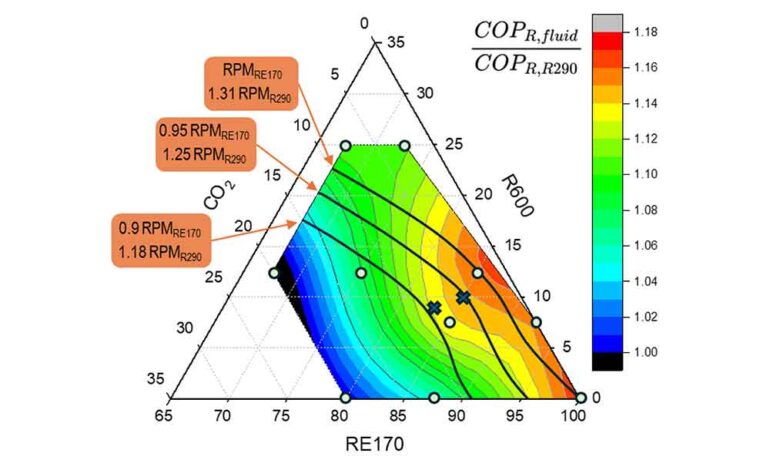
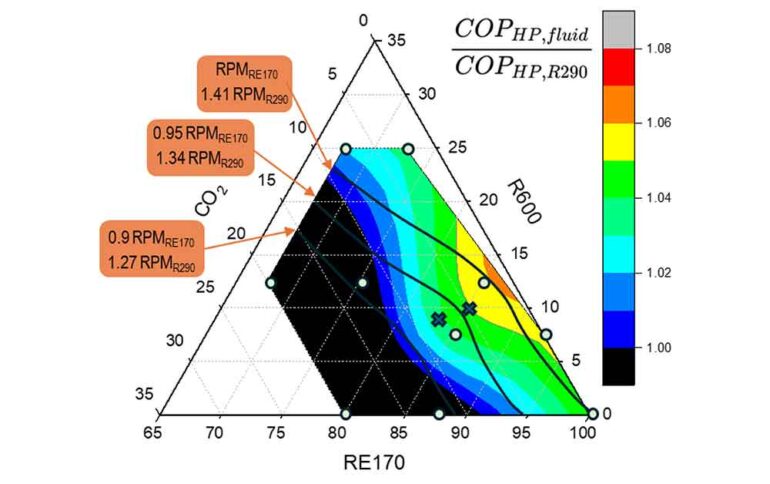
The research considered R290 and RE170 as pure fluids and 11 blends composed of different proportions of RE170/R600/R744. Evaluation covered three scenarios: a drop-in process with all the parameters maintained constant; a fixed cooling capacity test, where the compressor speed was increased to provide the same cooling capacity than with R290; and a fixed heat rejection capacity test to match the heat rejection of R290 in the condenser.
The experiments found that nearly all the mixtures and RE170 offer higher COP values for heating and refrigeration than R290, but all of them suffer large reductions in the capacity.
Based on these results, the use of pure RE170 was found to be the best overall alternative to R290. However, in systems where compressor size or speed is a limiting factor, mixtures such as RE170/R600/R744 (85/10/5) or (83/9/8) could be a suitable option, as they provide similar performance with slightly lower compressor speed.
The report published by the International Institute of Refrigeration is a available from the Science Direct website.