


GE freezes water with magnetics
12th February 2014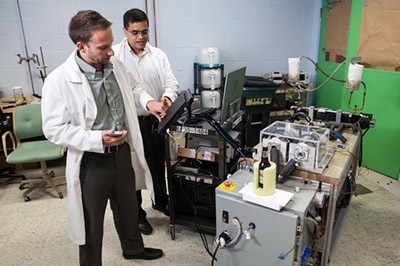
USA: Researchers working in General Electric labs claim to have been able to freeze water using magnetic refrigeration technology.
The idea of producing a super-efficient refrigerator by harnessing the magnetocaloic effect has been a target for scientists for decades but have previously ony been able to achieve cooling of just a couple of degrees Farenheit.
The breakthrough system, which is projected to be 20% more efficient than current refrigeration technology, could be inside a fridge by the end of this decade, they predict.
The magnetocaloric effect was first observed in the 1880s by German physicist Emil Warburg. Thomas Edison also toyed with the concept of building a magnetocaloric heat pump and in the 1980s a team at the Los Alamos National Laboratory in New Mexico used expensive superconducting magnets to achieve a few degrees of refrigeration.
GE teams in the US and in Germany picked up the problem again 10 years ago. They decided to build a cascade from special magnetic materials, where each step could lower the temperature just slightly. It took them five years to achieve cooling of just 2ºF.
The team’s got closer to a viable system when materials scientists developed a new type of nickel-manganese alloys for magnets that could function at room temperatures. Design engineers arranged the magnets in a series of 50 cooling stages. Today they are capable of reducing temperature by 80ºF.
“We are focusing on magnetic refrigeration as a potential replacement for all the refrigeration technologies currently in use,” said Michael Benedict, design engineer at GE Appliances.
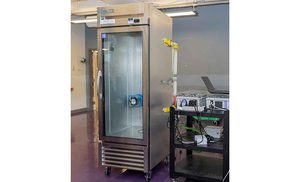
The GE team has run demonstrations for experts from the US Department of Energy, attended by staff from the White House and the EPA. “Nobody in the world has done this type of multi-stage cooling,” commented a research team leader Venkat Venkatakrishnan. “We believe we are the first people who shrunk it enough so that it can be transported and shown. We were also the first to go below freezing with the stages.”
The team is now working to achieve a 100ºF drop in temperature at low power. “We’ve spent the last 100 years to make the current refrigeration technology more efficient,” Venkatakrishnan says. “Now we are working on technology for the next 100 years.”