


Refrigeration vital to fusion project
3rd June 2014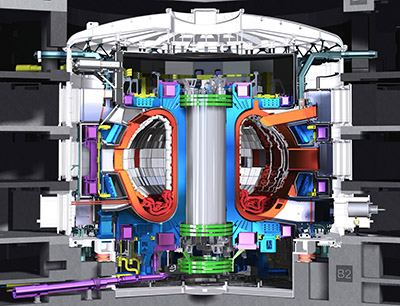
vessel and superconducting magnets, providing a super-cool, vacuum
environment
FRANCE: Air Liquide has won a new €65m contract to supply cryogenic refrigeration equipment to the ITER nuclear fusion project.
The ITER project is an initiative to develop an experimental reactor that will demonstrate the scientific and technical feasibility of fusion as a new source of energy. Fusion for Energy, the organisation that manages Europe’s contribution to ITER, has signed this latest contract with Air Liquide for the supply of cryogenic equipment that will complete the largest centralised refrigeration system ever built.
This is the second contract awarded to Air Liquide for the project. In December 2012, Air Liquide signed a €83m contract for the supply of three liquid helium plants. Working in parallel, these were designed to provide a total average cooling capacity of 75kW at 4.5K and a maximum cumulated liquefaction rate of 12,300 litres/hour.
The ITER project aims to make the long-awaited transition from experimental studies of plasma physics to full-scale electricity producing fusion power plants. The ITER cryogenic system employed is the largest concentrated system of its type in the world. Only the refrigeration system at the CERN Large Hadron Collider is larger.
The fusion reaction will be achieved in a tokamak device that uses magnetic fields to contain and control the hot plasma. The fuel — a mixture of deuterium and tritium is heated to temperatures in excess of 150,000,000°C, forming a hot plasma. The magnetic fields are produced by superconducting coils surrounding the vessel, and by an electrical current driven through the plasma. It has been designed to produce ten times the amount of energy put in.
The superconducting magnets only operate at extremely low temperatures. The cryogenic equipment supplied by Air Liquide makes this possible. It is based on the properties of liquid helium, whose temperature is only 4.5 ° C above “absolute zero” or – 273.15 ° C.
The equipment will be installed and commissioned on the ITER site in Cadarache, Saint-Paul-lez-Durance, near Marseille, from 2016.