


Solar trial drives aircon efficiency
18th June 2016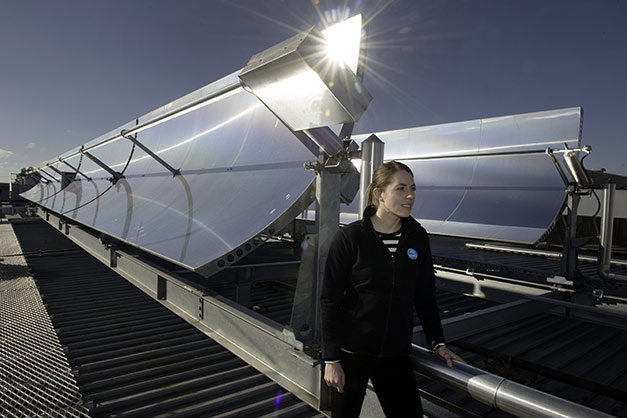
AUSTRALIA: Trials of a world-first, two-stage, desiccant air conditioning system suggest the technology could be viable for large scale commercial buildings.
The $1.2m demonstration project at Stockland Wendouree Shopping Centre in Ballarat, Victoria, is based on a closed-loop system using two ‘desiccant’ wheels to remove moisture from the air. The two-wheel design is expected to overcome the low efficiency of conventional single wheel systems.
The system can be used all year round and will supply space heating in winter, space cooling in summer and hot water all year round.
The Australian Renewable Energy Agency (ARENA) provided AUS$520,000 of financial support for the project, which was jointly managed by the government-backed Commonwealth Scientific and Industrial Research Organisation (CSIRO), the Stockland retailing group and solar collector manufacturer NEP Solar.
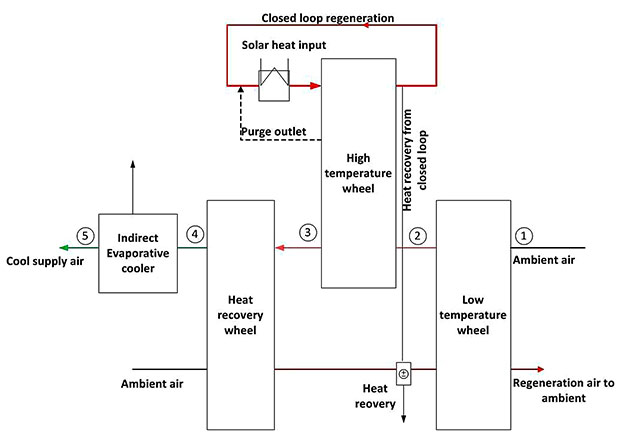
The design consists of two levels of moisture removal – a low temperature wheel and a high temperature wheel. A closed loop, solar heat driven, high temperature air stream is used for regenerating the high temperature wheel. There is no external heat source used for regeneration of the low temperature wheel. Heat for the low temperature regeneration is provided through a heat recovery wheel in the process air stream and heat recovered from the closed loop.
The closed loop regeneration and heat cascading design is expected to provide a high thermal COP compared with a conventional single-stage desiccant air conditioning system. Sensible cooling of the process air is achieved when air passes through an indirect evaporative cooler (IEC).
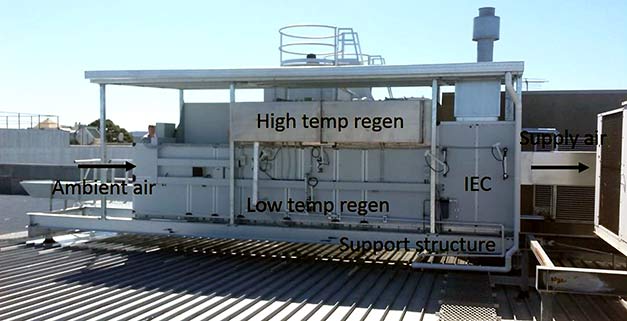
NEP installed parabolic trough collectors capable of delivering 70kW of heat at rated conditions along with a 2000 litre thermal oil storage tank. This system was integrated with the site space heating system and the solar air conditioning system so that solar heat can be utilised throughout the year.
The two-stage desiccant air conditioning system is designed to provide an airflow of 1100m³/hr and capable of delivering 10kW of cooling. The system uses high temperature heat at 150ºC to deliver cooling to the facility using the desiccant wheels, if the process air humidity is above 40%RH. Otherwise, the process air goes through only the indirect evaporative cooler.
The installed collectors have delivered over 1MWh of solar heat per month in the five months since installation. The desiccant air conditioning system delivered 10-12kW of cooling when operating in the desiccant cooling mode and 5-6kW of cooling when operating in the indirect evaporative cooling mode.
During this period, the unit operated with a mean thermal COP of 0.66 and an electrical COP of 7 (desiccant mode), and 10 (IEC mode). The IEC component of the unit is said to have been functioning consistently, providing the expected cooling to the building with wet bulb efficiencies of 80-100%.
CSIRO maintains that the results of the project indicate that high efficiency two-stage desiccant air conditioning systems could be scaled to higher capacities of 50-100kW of cooling capacity. As a result they are likely to be suitable for large scale commercial buildings that can utilise rooftop solar collectors, or industries that have waste heat or steam available for desiccant regeneration.