


Fan retrofit provides sky-high savings
3rd June 2023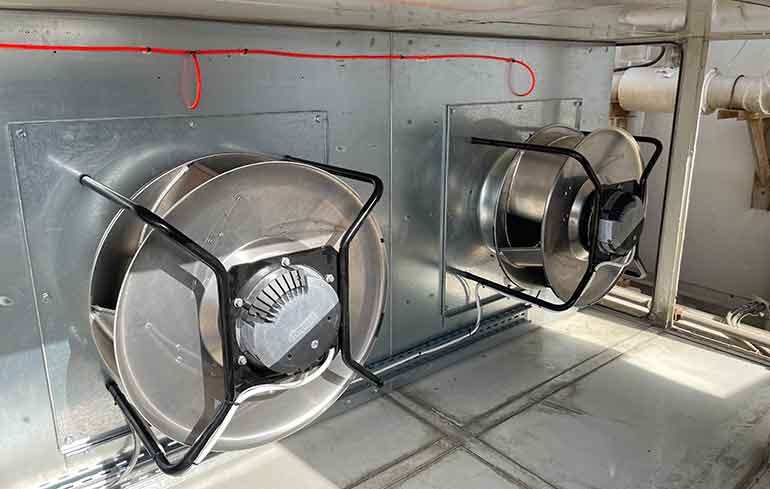
DUBAI: A fan retrofit to air handling units in a high-rise building in Dubai has helped achieve a 60% reduction in energy consumption.
The 40-storey Swiss Tower in Dubai houses a mix of offices and luxury apartments. The building is constantly supplied with fresh, cooled air from a total of four AHUs. Completely replacing old ventilation systems is time-consuming and costly, so a retrofit option using energy-efficient fans and combined with a demand-oriented control concept was chosen. The retrofit option also provided the opportunity to reduce energy costs and increase the service life of the system.
The solution was provided by locally-based specialist HVAC company Qey with its MatrixAir+ EC fan package, consisting of fan terminal boxes, fan bulkheads, control panels and EBM‑Papst RadiPac fans with EC technology.
Delivered as a complete package solution, the new fans were quick and easy to install. A total of 26 RadiPacs were installed as a FanGrid in the intake and outlet section of the four AHUs. This redundant design increases the reliability of the system and provides greater operational reliability.

The service life of the system is also extended by operating several small EC fans at partial load as required instead of a large AC fan constantly at full load, as was previously the case. The air also flows through upstream and downstream components, such as filters or heat exchangers, more evenly. This leads to more efficient heat transfer and air filtering, in turn reducing the operating costs of the system.
The RadiPac EC fans claim a high motor efficiency level of over 90%, contributing to significant energy savings compared to conventional AC motors.
The second part of the retrofit involved upgrading the control system. Thanks to the security scans at the inlet and outlet, data was available on the building’s capacity utilisation according to the time of day.
In cooperation with Taka Solutions, a Dubai-based energy efficiency services company, Qey used this data to determine the air flow requirements depending on the time of day and programmed a schedule for optimised control of the building ventilation using a software specially developed for retrofit projects.
The RadiPac RS485/MODBUS RTU interface is said to provide the perfect conditions for this, as it enables the fans to be controlled according to requirements while also allowing the operating data of each individual fan to be monitored.