


IMechE: refrigeration must feed the world
30th June 2014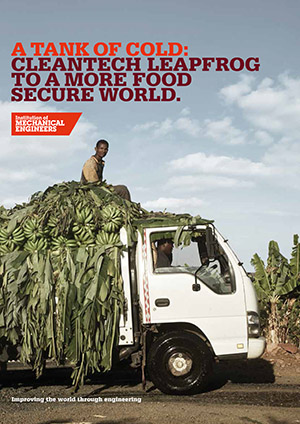 UK: The Institution of Mechanical Engineers has called for urgent action to roll out a sustainable cold chain in the developing world.
The London-based Institution of Mechanical Engineers (IMechE), one of the oldest established professional engineering institutions with over 100,000 members in more than 140 countries, makes the plea today in a new report – A tank of cold: cleantech leapfrog to a more food secure world.
A follow up to the IMechE’s report last year which estimated that up to 50% of food produced around the world is either lost or discarded, the new document calls for new measures to prevent unnecessary food loss, help alleviate hunger and improve global food security.
According to the report, it is estimated that about 25% of food wastage in the developing world could be eliminated with better refrigeration equipment. Other figures from the report claim that up to 50% of fruit and vegetables are lost in sub-Saharan Africa and India, while Tanzania sees 25% of all milk produced in the wet season end up as wastage and 97% of its meat sold warm having never been chilled.
Amongst a number of measures, the IMechE calls on the UK engineering community to come together to define in detail the potential opportunities a joined-up cold economy presents for the developed and developing world.
“Hunger, as well as illness from poor quality food, continues to be a significant problem in many parts of the world, and this is potentially set to get worse as global population rises,” commented Dr Tim Fox, the IMechE’s head of energy and environment.
“Governments and aid agencies simply funding the production of more and more food which is then spoilt and discarded is a poor use of the money, often from taxpayers or donations, and does not provide a long-term and sustainable solution to the problem of global poverty and local self-sufficiency.”
“We currently produce enough food, but the tragedy is that too much of it is lost unnecessarily through spoilage in developing countries, where it is most needed, due to inadequate infrastructure and in particular a lack of cold and frozen supply chains.
“It is a travesty that up to 50% of fruit and vegetables are lost in Sub-Saharan Africa and India, while Tanzania sees 25% of all milk produced in the wet season end up as wastage and 97% of its meat sold warm having never been chilled.
“Investment in cold chain infrastructure driven by renewable energy is the key to preventing these losses, alleviating world hunger and improving health. It also presents farmers and rural communities with attractive business opportunities for development.
“Donor Governments, like the UK and USA, NGOs involved in development initiatives and retailers establishing supply chains, need to prioritise investment into affordable, reliable and sustainable cold chain infrastructure. This includes combining renewable energy with innovative technologies for producing both power and cooling, such as for example cryogenic energy storage using liquid air or nitrogen.”
Many developing countries have little or no connectivity to a large-scale electricity grid: 70% of people in sub-Saharan Africa have no access to electricity at all and 350 million people in India are located off-grid in rural locations. Building on existing ambitions for electricity access and energy security, the report says that governments of these countries have a role to play in encouraging development of community renewable energy projects with energy storage to provide the cold/freezing needed for effective rollout of sustainable cold chains.
The IMechE recommends that governments of newly emerging and rapidly industrialising economies must prioritise support investment in cold chain infrastructure to improve food security, underpin development and help alleviate poverty. It calls on donor country governments and development NGOs to support and incentivise aid recipients to develop sustainable cold chains using renewable energy and waste cold.
Refrigeration is key
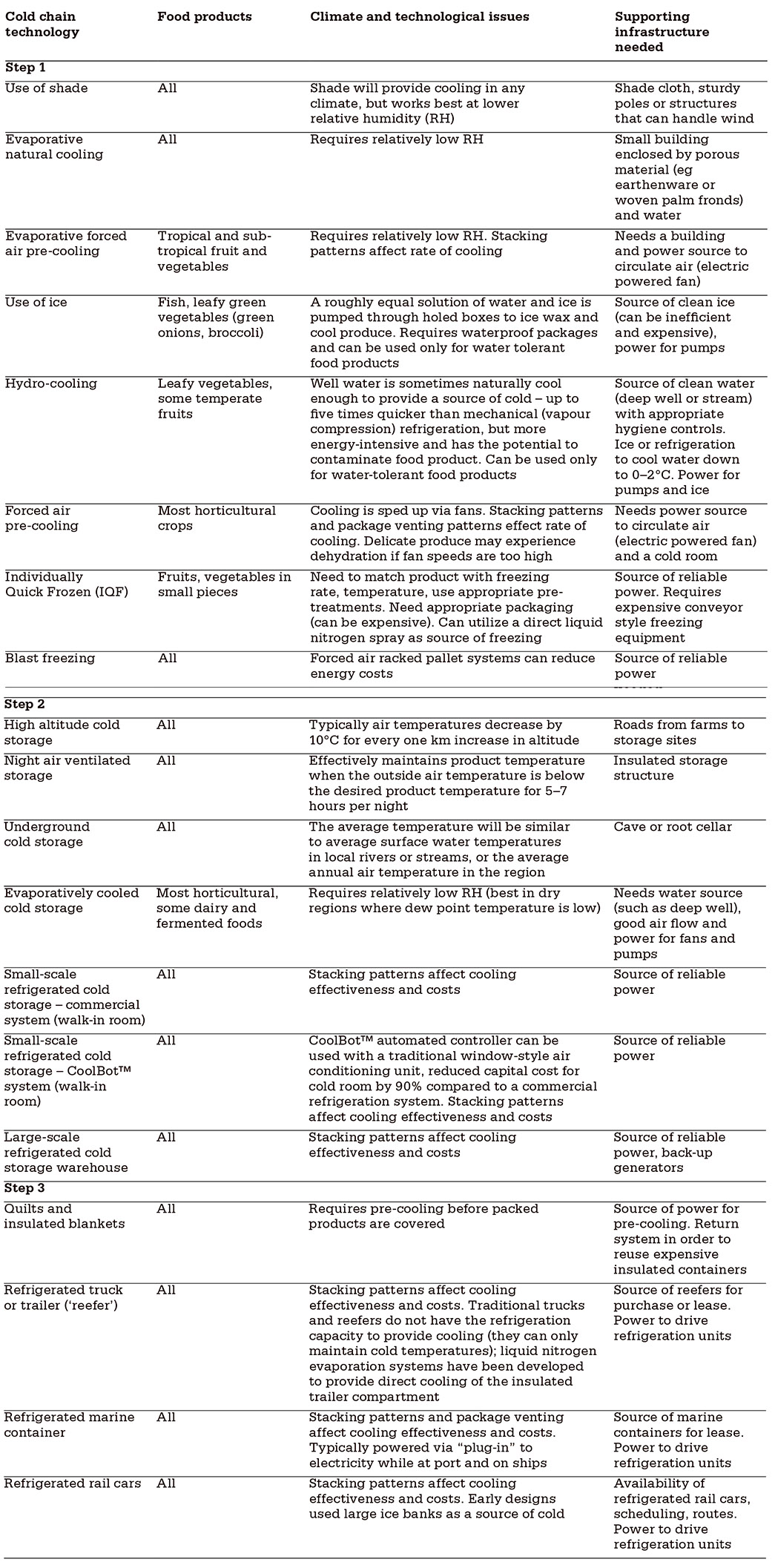
Refrigeration, or at least cold, is identified as the key to tackling the loss of perishable produce in the report and calls for the establishment of a continuous chain of temperature-controlled cold environments from the point of harvest to the marketplace.
Renewable energy is seen as major part of the answer for power generation but a range of energy storage solutions are required that meet the needs of a developing economy, and are either commercially available today, or in development and close to market.
One contender identified in this regard is cryogenic energy storage, using liquified air. In addition to providing on-demand power and cooling for pre-cooling, chilling, freezing and cold storage, liquid air could drive a simple cryogenic piston engine that can form the basis of a zero-emissions refrigeration unit for transport vehicles.
This report shows how by locating a cryogenic energy storage facility at an agricultural ‘hub’ in a rural location, effectively establishing a local ‘tank of cold’, sustainable power and cooling can be provided to drive all three cold chain steps.
The full report can be accessed here.