


Tesco first with CO2/R1270 refrigerated truck
16th April 2024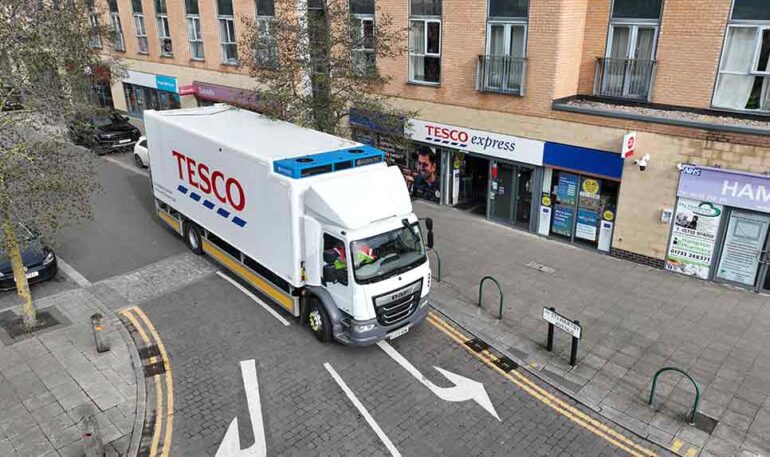
UK: Tesco is the first company in the UK to use refrigerated vehicles with a German manufactured refrigeration unit using CO2 and R1270 (propene).
Gray & Adams, the British temperature-controlled vehicle manufacturer, jointly developed a refrigeration body with Ecooltec Grosskopf GmbH, using the German company’s Ecooltec TM182 transport refrigeration system.
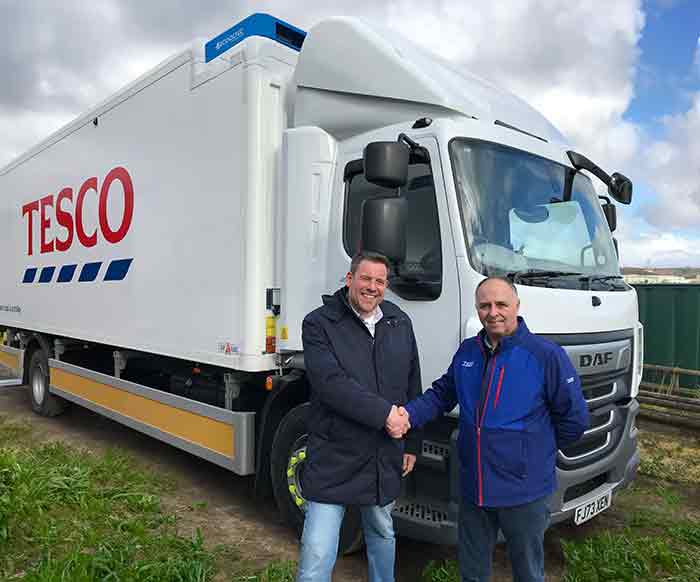
The supermarket giant has taken delivery of two 18-ton trucks with refrigerated bodies and the purely electrically powered Ecooltec transport refrigeration system. These are now running between the Tesco warehouse in Peterborough and the surrounding Tesco branches.
A multitemp box body with a movable partition makes it possible to set up two compartments for simultaneous frozen and fresh service operations as required.
Inside the refrigerated case, a single Ecooltec evaporator in the front compartment and a double evaporator in the second chamber distribute the cold air. The electrical energy to drive the TM182 is generated by the Ecooltec generator G30, which is connected to the truck engine. At the depot, the transport refrigeration system can also be powered via a land-based cable.
The company claims to have protected the system against leaks in the body with a patent-pending, fully hermetic refrigeration circuit. The specially-designed heat exchanger and the use of propene also reduces the amount of refrigerant used by 90% compared to conventional transport refrigeration systems.
In the box body, the natural refrigerant CO2 is used for the cold distribution. Outside the body, the R1270 and CO2 circuits flow past each other, thermally connected via a plate heat exchanger.
As well as producing no local pollutant and CO2 emissions when operating on batteries and up to 98% fewer emissions compared to diesel-powered refrigeration systems, the Ecooltec is said to have a large cooling capacity and low energy consumption. For the same cooling capacity, the system is said to use 60-80% less energy than a conventional diesel-powered system.
Noise levels are also said to be significantly lower than with comparable diesel refrigeration machines.
Related stories:
Electrically-driven TRU uses R1270 and CO2 – 6 August 2022
GERMANY: Transport refrigeration company Ecooltec Grosskopf has developed a new generation of electrically-driven transport refrigeration unit using CO2 and the hydrocarbon refrigerant R1270 (propene). Read more…