


Hauser debuts magnetocaloric cabinet
6th April 2026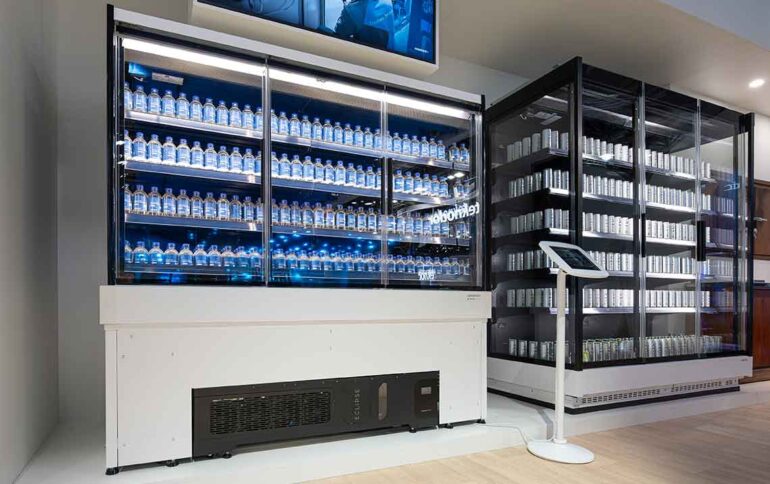
GERMANY: Hauser has produced a prototype commercial refrigerated cabinet that, based on magnetocaloric technology, dispenses with conventional refrigerants.
Displayed at February’s Euroshop exhibition, and dubbed the Renimag, the cabinet combines a Hauser Renima unit with magnetic cooling technology developed by Magnotherm, a spin-off from the Technical University of Darmstadt.
The Renimag prototype, using only water as the cooling medium, operates at just 1bar and has a capacity of around 1kW. Initial tests are said to have exhibited a 15% efficiency improvement compared to propane systems.
The magnetocaloric effect is a phenomenon in which certain materials warm up when a magnetic field is applied, and release heat when the magnetic field is removed.
The system currently achieves temperatures between 0ºC and 30ºC, but Magnotherm MD and founder Timur Sirmanin insists that ranges from –5ºC to 50ºC as well as deep‑freeze applications will be possible in the future.
Sirmanin also reports that energy consumption is significantly lower than that of conventional systems, while less waste heat is generated. In addition, the system operates only 1-2K above ambient temperature, further increasing efficiency.
The strength of Magnotherm’s technology is said to lie in the combination of materials science and classical mechanical engineering. “Three technological breakthroughs have made our system market‑ready: first, we have developed a very stable, scalable system. Second, magnetocaloric materials can now be produced in series at realistic costs. Third, our concept can be scaled to capacities ranging from 50kW to 500kW,” he said.
As well as being very quiet, the system is sais to be particularly safe due to the low operating pressure. The magnetocaloric material shows no fatigue, promising a long service life. Initial tests on a retail partner’s converted refrigerated island that was previously operated with propane, is said to have shown an efficiency increase of around 15%. In the long term, efficiency gains of up to 30% are considered realistic.
Current disadvantages include the larger design, higher weight and higher costs compared to conventional systems. Performance also still has room for improvement. The most expensive single component is the permanent magnet, but in the long term, costs are expected to fall through scaling and reuse of components,” Sirmanin reveals on the Hauser website.
Related stories:
Alloy stabiliser advances magnetic cooling – 22 January 2025
GERMANY: Magnetic cooling company Magnotherm claims a significant advancement in the technology by protecting magnetocaloric alloys from corrosion and mechanical fracture. Read more…
Magnetocaloric firm attracts €6.3m funding – 12 April 2023
GERMANY: A Darmstadt-based magnetic cooling startup company has attracted €6.3m of financing to drive forward the series production of refrigerators using the technology. Read more…