


Jordan test for CO2 refrigeration
3rd March 2018
JORDAN: The Al Salam military supermarket in Amman, Jordan, has become the testbed for the Middle East’s first trial of a transcritical CO2 refrigeration system.
The project seeks to prove the feasibility of non-HFC-based technology in high ambients. It is being implemented by the United Nations Industrial Development Organisation (UNIDO) with the support of the Ministry of Environment of Jordan, and is funded by the Climate and Clean Air Coalition (CCAC).
The Climate and Clean Air Coalition’s HFC Initiative brings together governments, private sector, and intergovernmental organisations to share knowledge and strategies for developing, deploying, and promoting climate-friendly technologies in an effort to transition away from high-GWP HFCs and minimise HFC leakages.
The work in Jordan is part of three ongoing demonstration projects in Chile, Jordan and India to showcase the possibilities of HFC alternative technologies in commercial refrigeration and mobile air conditioning and will provide information on the performance and energy use associated with these alternatives.
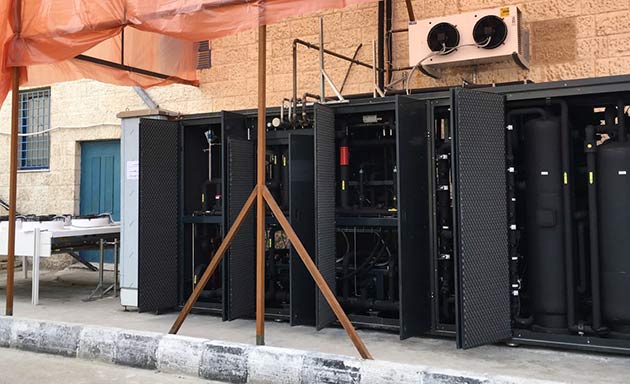
The aim of the project is to demonstrate the feasibility and monitor efficiency results of systems with CO2 as the working fluid and as an alternative to R22 in retail installations that are still often used in many developing countries.
The installed system at the 2,000m² Al Salam supermarket is a CO2 transcritical booster system with parallel compression.
To ensure high efficiency also during the high ambient temperatures in the summer months, the system employs multi-ejector technology and features non-superheated evaporator technology for both chilled and frozen food cabinets and storage rooms. The waste heat from the system can be recovered for hot sanitary water supply.
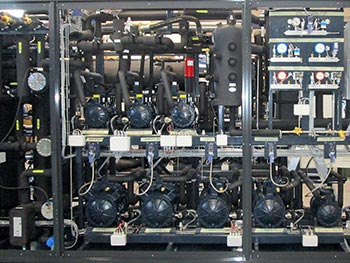 Net capacity on the medium temperature side accounts for 31kW and the gross capacity 69kW at -2°C. The low temperature capacity amounts to 38kW at -25°C.
The technology supplier of the project is Abdin Industrial, a Jordanian family-owned company, which provided the four and five door cabinets, set up all piping and finalised the on-site installation.
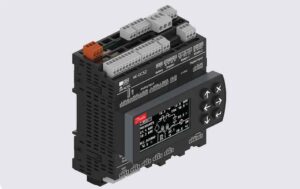
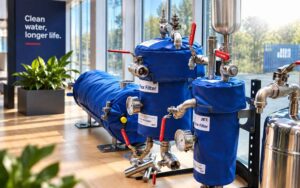
The company worked closely with Italian-based international system manufacturer Enex who supplied the refrigeration system. Core components used in the installation come from Alfa Laval, Danfoss, Dorin, Lu-Ve, Temprite and others.
The new refrigeration system in the supermarket in Amman, Jordan, is able to maintain chilled food at the set-point temperatures with an evaporation temperature of -2°C, while the frozen foodstuff is cooled by evaporating CO2 at -25°C.”