


Mitsubishi compressor motor wins top award
6th June 2024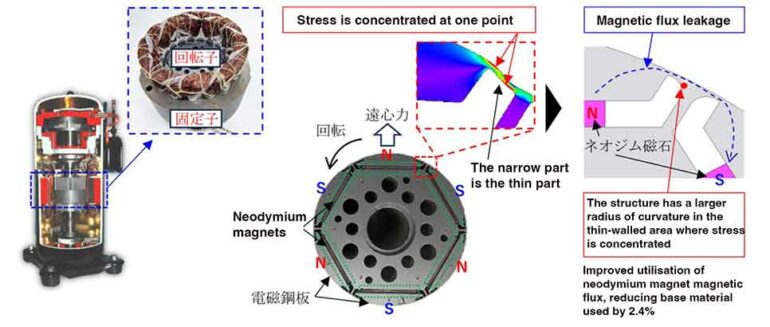
JAPAN: Mitsubishi Electric has received a top Japanese award for the technology related to its compressor motor that reduces the use of rare earths by effectively using magnetic flux.
The motor developed by Mitsubishi Electric, which has been used in its heat pump air conditioning compressors since 2013, has won an Invention Award at Japan’s 2024 National Invention Awards.
The National Invention Award has been held since 1919 with the aim of contributing to the improvement of science and technology and the development of industry in Japan.
Neodymium magnets are recognised as the strongest commercially-available permanent magnet and are commonly used in applications where high performance compact motors are a crucial factor. They have attracted attention as a way to realise a carbon-neutral society, and in permanent magnet embedded motors used in electric vehicles and plug-in hybrid vehicles.
However, being a rare earth element, neodymium is difficult to extract and only produced in small quantities, and so there is a need to develop technology that can reduce its use.
The rotor of a permanent magnet embedded motor is made of electromagnetic steel sheets and multiple neodymium magnets. A thin section connects the rotor outer circumference to the air gap to prevent the rotor from being destroyed by centrifugal forces.
However, some of the magnetic flux passes through the thin section, causing magnetic flux leakage and reducing performance. So, it became a challenge for motor manufacturers to reduce the stress caused by centrifugal forces while at the same time increasing the effective magnetic flux.
Mitsubishi Electric noticed that the stress caused by the centrifugal force was concentrated at one point in the thin-walled part, and invented a new structure that could reduce the width of the thin-walled part while reducing the stress at the high stress point. This improved the utilisation rate of the magnetic flux while reducing the amount of neodymium used.