



New material could reduce air conditioning load
27th November 2014
USA: Engineers at Stanford University, California, claim to have invented a new mirror-like material which could reduce the air conditioning load of buildings.
The inventors say the new ultrathin multilayered material can cool buildings by radiating warmth from inside the buildings into space while also reflecting sunlight to reduce incoming heat. The result is cooler buildings that require less air conditioning.
A team led by electrical engineering professor Shanhui Fan and research associate Aaswath Raman reported this energy-saving breakthrough in the journal Nature.
“This is very novel and an extraordinarily simple idea,” said Eli Yablonovitch, a professor of engineering at the University of California, Berkeley, and a pioneer of photonics who directs the Center for Energy Efficient Electronics Science. “As a result of professor Fan’s work, we can now use radiative cooling, not only at night but counter-intuitively in the daytime as well.”
The researchers say they designed the material to be cost-effective for large-scale deployment on building rooftops. Though still a young technology, they believe it could one day reduce demand for electricity.
In practice the researchers think the coating might be sprayed on a more solid material to make it suitable for withstanding the elements.
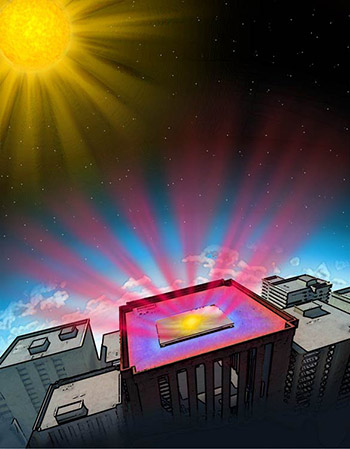 “This team has shown how to passively cool structures by simply radiating heat into the cold darkness of space,” said Nobel Prize-winning physicist Burton Richter, professor emeritus at Stanford and former director of the research facility now called the SLAC National Accelerator Laboratory.
A warming world needs cooling technologies that don’t require power, according to Raman, lead author of the Nature paper. “Across the developing world, photonic radiative cooling makes off-grid cooling a possibility in rural regions, in addition to meeting skyrocketing demand for air conditioning in urban areas,” he said.
Precise frequency
The first part of the coating’s one-two punch radiates heat-bearing infrared light directly into space. The ultrathin coating was carefully constructed to send this infrared light away from buildings at the precise frequency that allows it to pass through the atmosphere without warming the air. This is a key feature, say the inventors, given the dangers of global warming.
In addition, the multilayered coating also acts as a highly efficient mirror, preventing 97% of sunlight from striking the building and heating it up.
“We’ve created something that’s a radiator that also happens to be an excellent mirror,” said Raman.
Together, the radiation and reflection are said to make the photonic radiative cooler nearly 9ºF cooler than the surrounding air during the day.
The multilayered material is just 1.8 microns thick, thinner than the thinnest aluminum foil. It is made of seven layers of silicon dioxide and hafnium oxide on top of a thin layer of silver. These layers are not a uniform thickness, but are instead engineered to create a new material. Its internal structure is tuned to radiate infrared rays at a frequency that lets them pass into space without warming the air near the building.
“This photonic approach gives us the ability to finely tune both solar reflection and infrared thermal radiation,” said Linxiao Zhu, doctoral candidate in applied physics and a co-author of the paper.
“I am personally very excited about their results,” said Marin Soljacic, a physics professor at the Massachusetts Institute of Technology. “This is a great example of the power of nanophotonics.”
But it’s not all plain sailing; making photonic radiative cooling practical requires solving at least two technical problems.
The first is how to conduct the heat inside the building to this exterior coating. Once it gets there, the coating can direct the heat into space, but engineers must first figure out how to efficiently deliver the building heat to the coating.
The second problem is production. The prototype is the size of a small pizza. Cooling buildings will require large panels. The researchers say there exist large-area fabrication facilities that can make their panels at the scales needed.
More broadly, the team sees this project as a first step toward using the cold of space as a resource. In the same way that sunlight provides a renewable source of solar energy, the cold universe supplies a nearly unlimited expanse to dump heat.
“Every object that produces heat has to dump that heat into a heat sink,” Fan said. “What we’ve done is to create a way that should allow us to use the coldness of the universe as a heat sink during the day.”