


New sorbent boosts efficiency
11th April 2018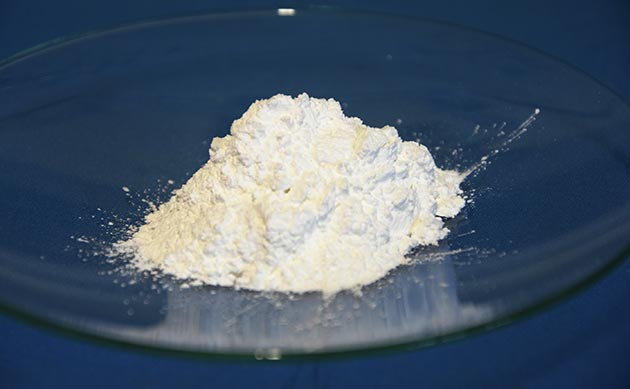
GERMANY: Scientists in Germany claim to have developed a new more efficient sorbent for use in adsorption chillers.
A research team at the Institute of Inorganic Chemistry at Kiel University, together with the Fraunhofer Institute for Solar Energy Systems ISE in Freiburg, has developed a highly-porous material for use in adsorption systems which enables the efficient use of unused waste heat from, for instance, district heating systems, data centres, or heat from solar thermal collectors.
Sorbents used in cooling systems are traditionally crystalline zeolites or silica gels, which can easily absorb water due to their structure. The new substance, highly-porous aluminium isophthalate, known as CAU-10-H, is said to be able to absorb a lot of water very quickly, and also release it quickly again – even at a low increase in temperature.
The Kiel working group has already been working on new metal organic frameworks (MOF) for a long time. For transfer to an industrial application, they worked with colleagues from the Fraunhofer ISE to coat commercially available heat exchangers with their material.
“The survey of the heat exchanger under application-related conditions shows the high potential of the material,” said Dr Stefan Henninger from the ISE. In the laboratory, the material can already be produced in kg quantities under mild reaction conditions, ie at a temperature of 100°C with water as a solvent. “In order to produce the material for an industrial use on a larger scale, our next step is to contact other companies,” said Stock. They have already applied for a patent for their production method.
“This could also make an important contribution to the use of renewable energies,” said Professor Norbert Stock from the Institute of Inorganic Chemistry. For environmentally friendly systems like this the material is said to have two key advantages: “The systems consume less power, and we can produce the material in an eco-friendly manner,” explained the inorganic chemist.
The research team will be presenting the material and its applications at the Kiel University booth at the Hannover Messe (Hall 2, Research & Technology, Booth C07) from April 23 to 27. In addition, Professor Stock will present a lecture on-site on Wednesday April 25 at 2.30pm and 5pm, titled Nanoporous materials for modern and environmentally-friendly cooling and air-conditioning.
More details here.