


Pressure exchanger improves CO2 refrigeration efficiency
3rd November 2024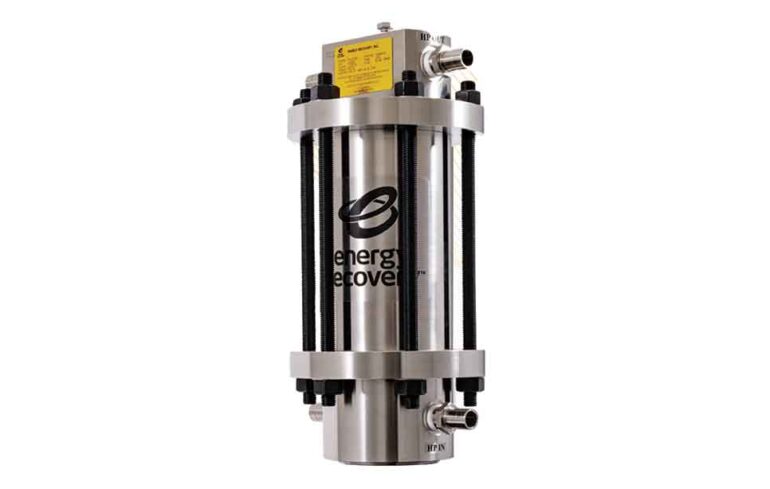
USA: A technology adapted from the desalination industry is said improve COPs of CO2 refrigeration systems by up to 30%.
The PX G1300 from California-based Energy Recovery Inc is described as an innovative application of the company’s PX pressure exchanger, an energy efficiency device for seawater reverse osmosis desalination.
The efficiency of CO2 systems is known to decline in hot weather, leading to higher electricity costs in the summer. Many current solutions leverage water to keep up system efficiency in the heat, which creates challenges of water cost, availability and maintenance.
Additionally, refrigeration systems operate within a fixed capacity (design temperature), causing strain during heat waves and potentially leading to system failure.
New research revealed in a white paper suggests that the PX G1300 can aid in solving all three problems by increasing energy efficiency and cooling capacity without water. Findings showed the PX G1300 improved the leading metric of COP by peaks of up to 30% with as much as 15% in projected annual energy savings.
In essence, it works by recycling CO2 system pressure, transferring energy between high and low pressure CO2 refrigerant through continuously rotating ducts.
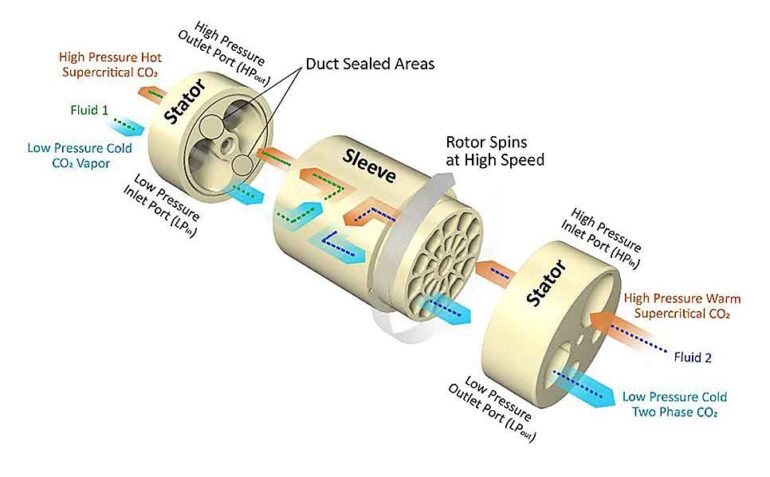
In addition to energy efficiency, findings estimate the PX G1300 increases cooling capacity for CO2 refrigeration systems by up to 15% at 95°F (35°C), providing operational flexibility to safeguard against heatwaves.
In the three decades since it was first introduced for water desalination, the Energy Recovery PX pressure exchanger has expanded to accommodate a wide range of pressure and flow levels, making it suitable for a large variety of water treatment processes including industrial wastewater treatment, brackish water treatment, and water reuse.
Energy Recovery has shown that the PX G can also perform gas compression, in CO2 transcritical compression and can simultaneously act as a compressor and an expander. Energy Recovery further demonstrated that the PX can help improve the efficiency of CO2 refrigeration systems significantly. Higher discharge pressures observed in CO2 refrigeration systems provide an opportunity for the PX to recover that high differential pressure energy and use it to save the compression work required by the system.
Energy Recovery has applied its core pressure exchanger technology to the PX G1300, which can handle liquid, gas, supercritical fluids, and the two-phase liquid gas mixtures and deliver the energy savings and the emissions reductions for CO2 refrigeration systems.