


Report highlights unexplained CFC emissions
31st October 2022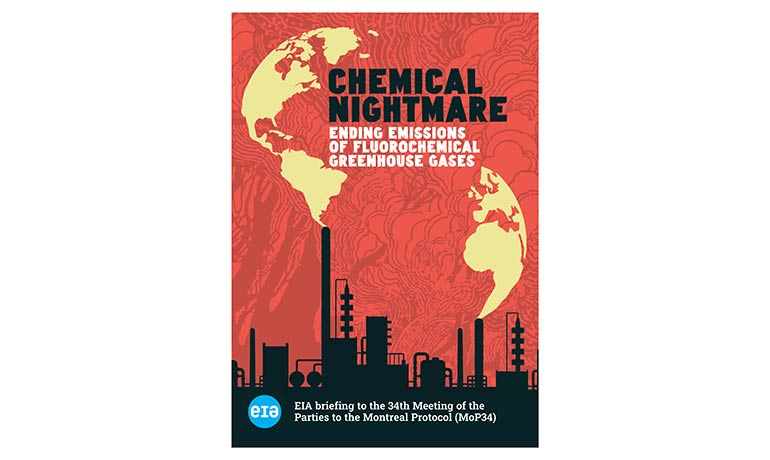
UK: The Environmental Investigation Agency (EIA) has highlighted reports of unexplained emissions of ozone-depleting CFC gases that continue to damage the planet’s ozone layer and are adding to global warming.
The report, Chemical Nightmare – Ending Emissions of Fluorochemical Greenhouse Gases, is released as the 34th Meeting of the Parties to the Montreal Protocol (MoP34) opens in Montreal, Canada.
In 2018, scientists discovered unexpected emissions of CFC11, an ozone-depleting substance which, before being phased out under the Montreal Protocol, was commonly used as a refrigerant and insulation foam propellant. EIA investigations traced the source to illegal production and use in the polyurethane foam sector in China, which had gone undetected for years by the Montreal Protocol’s existing monitoring and compliance mechanism.
The EIA now reports that the latest scientific findings suggests that emissions of CFC11 are just the tip of the iceberg. While emissions of CFC11 from China’s insulation industry declined after their source was revealed, a recent study in Nature Communications reported new unexpected emissions of CFC11 and CFC12. The latter was the air conditioning gas prior to R22 and has a GWP of 11,200 under AR6.
The UN Environment Programme’s latest Scientific Assessment Panel (SAP) report also draws attention to unexplained emissions of a basket of CFCs as well as ozone-depleting carbon tetrachloride and HFC23, attributing emissions to feedstocks, by-products or unknown sources.
While the source is unknown, carbon tetrachloride is a feedstock for CFC11, and CFC12, which is co-produced with CFC11. According to the EIA, carbon tetrachloride is still widely used as a feedstock in the production of HFCs and HFOs.
HFC23, with its GWP of 14,600, is one of the most potent man-made greenhouse gases. It is a by-product of HCFC22 production, which is primarily also used as a feedstock to make HFCs and HFOs. Under the Kigali Amendment, producers are required to ensure any by-product emissions of HFC23 are
“destroyed to the extent practicable”.
The Scientific Assessment Panel estimates that the current combined GWP-weighted emissions of CFCs plus HCFCs are comparable to those of HFCs.
“We urge the Montreal Protocol to take immediate action to address these emissions and to include all fluorochemical industrial processes in a comprehensive review of the Protocol’s institutions,” said EIA UK climate campaign leader Clare Perry.
Related stories:
CFC11 emissions decline after crackdown – 10 February 2021
USA: Global levels of the banned ozone-depleting chemical CFC11 are nearly back to pre-2008 levels after an unexpected recent spike in emissions. Read more…
CFC11 “widely produced” in China – 25 June 2018
USA: The Environmental Investigation Agency (EIA) claims to have evidence that illegal CFC11 is being widely produced and used in China. Read more…
Scientists pinpoint major source of CFC11 emissions – 22 May 2019
UK: An international team of atmospheric scientists has pinpointed eastern China as the major source of the rise in emissions of ozone depleting CFC11 first reported last year. Read more…
China promises crackdown on CFC11 – 4 August 2018
CHINA: Chinese authorities have announced a crackdown on the illegal use and production of ozone-depleting substances, including CFC11. Read more…
Action promised to stop CFC11 use – 18 July 2018
AUSTRIA: The delegates to last week’s Montreal Protocol meeting have promised “a sweeping response” to evidence of a rise in CFC11 emissions. Read more…
CFC11 in China a “massive crime” – 9 July 2018
AUSTRIA: A shocking new report suggests the illegal production and use of the long-banned ozone-depleting chemical CFC11 is common practice in China. Read more…
Mysterious rise in CFC11 emissions – 16 May 2018
USA: An ozone depleting CFC refrigerant, thought to be virtually extinct following Montreal Protocol phase outs, has mysteriously reappeared in increasing amounts in the atmosphere. Read more…