


Scientists claim elastocaloric cooling breakthrough
21st September 2026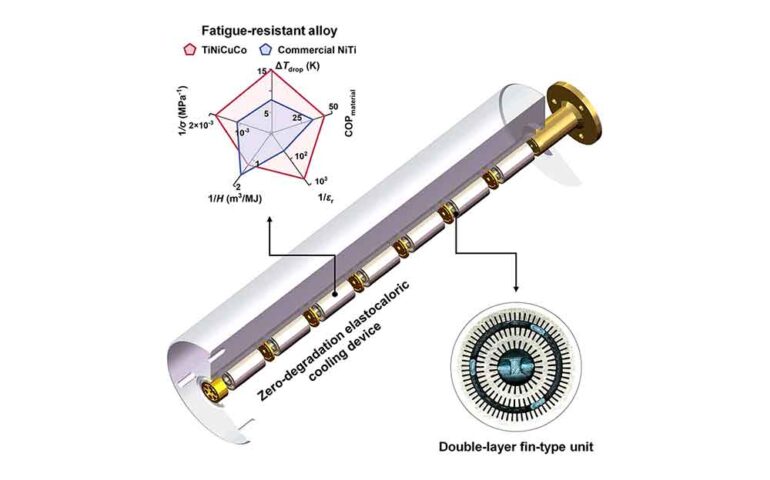
HONG KONG: Scientists claim to have developed what is said to be the world’s first zero-degradation elastocaloric cooling device.
Powered by a fatigue-resistant, solid-state refrigerant, this innovation is said to deliver durable and green cooling, maintaining its stable performance even over one million operational cycles.
The development team from the Hong Kong University of Science and Technology (HKUST) claims that the breakthrough will usher in highly efficient eco-friendly cooling, driving progress towards sustainable global development.
Elastocaloric cooling, which is based on the reversible stress-induced phase transformation of shape memory alloys, offers a promising green alternative to traditional refrigeration. However commercialisation has been impeded by performance degradation and low reliability.
The prevalent use of commercial NiTi shape memory alloys as the refrigerant in most existing elastocaloric cooling devices is seen as a key challenge. This material is prone to functional fatigue, causing its cooling power to decline over extended use.
The TiNiCuCo alloy developed by the HKUST team is said to exhibit significantly superior fatigue-resistance. The double-layer fin-type refrigerant structure was designed and fabricated to enhance both heat transfer efficiency and buckling resistance, achieving an ultra-high fatigue life exceeding 10 million cyclic compressive cycles.
This innovative design is said to have achieved a 50% reduction in components and reduced the proportion of ineffective parts from 15% to 5%.
The elastocaloric cooling device achieved a constant cooling power of 400W and maintained a constant temperature span of 41K over one million operation cycles without degradation. Accelerated fatigue testing of the TiNiCuCo refrigerant also showed no functional degradation after 100 million cycles. Under real-world cooling conditions, the refrigerant is expected to operate reliably for more than a decade.
Team leader Prof Qingping Sun stated: “This breakthrough in cooling stability, achieved at both the material and device levels, brings the technology one step closer to real-world applications beyond laboratory demonstrations. We are currently developing an air conditioner based on this technology. Moving forward, we aim to further enhance energy efficiency, power density, and cost competitiveness of elastocaloric refrigeration systems to accelerate their market adoption as a sustainable cooling solution.”