


Scientists find rapid test for legionella
22nd March 2018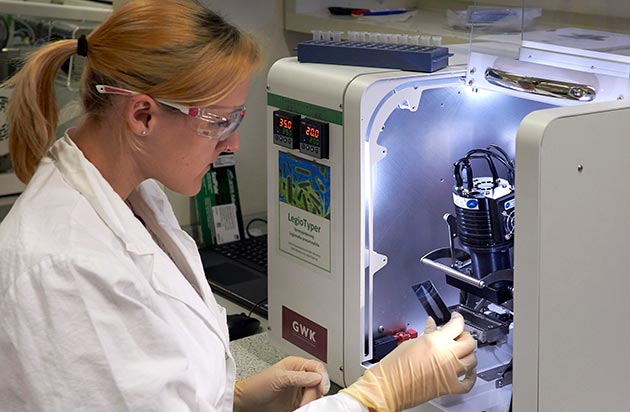
GERMANY: Researchers at the Technical University of Munich claim to have developed a rapid test for legionnaires’ disease.
In the event of an outbreak of legionnaires’ disease, finding the exact source as quickly as possible is essential to preventing further infections. Until now, a detailed analysis has taken days. The new rapid test developed by the team from Munich University can provide the same result in about 35 minutes.
Similar to a paternity test, the origin of the outbreak is confirmed when the germs in the process water of a system exactly match those identified in the patient. However, often numerous systems must be tested in the process, and the requisite cultivation for the test takes around ten days.
Faster detection with antibodies
There is already a rapid test for detecting the legionella pathogen in the clinic by identifying compounds of legionella in the urine of patients. “Unfortunately, this quick test serves only as a first indication and is not suitable for screening the water of technical systems,” said PD Dr Michael Seidel, head of the research group at the chair of analytical chemistry and water chemistry of the Technical University of Munich.
The team of scientists have developed a measuring chip that not only detects the dangerous pathogen legionella pneumophila but also identifies which of the approximately 20 subtypes is present.
Using 20 different antibodies, the system provides a complete analysis within 34 minutes.
“Compared to previous measurements, the new method not only provides a huge speed advantage, but is also so cheap that we can use the chip in one-time applications,” Seidel added.
The system can be deployed for environmental hygiene as well as clinical diagnostics. In combination with a second, DNA-based method, the system can even distinguish between dead and living legionella pathogens. This allows the success of disinfection measures to be monitored.
The project participants will present their system to the public for the first time at the Analytica 2018 trade fair in Munich in April.