



US identifies vapour-compression options
30th March 2014 USA: The US Department of Energy has identified 17 technologies which could potentially replace traditional vapour compression technology in hvac systems.
With traditional HFCs coming under increasing pressure there is a global move towards low-GWP HFCs, hydrocarbons, ammonia, carbon dioxide, and hydrofluoro-olefins (HFOs) as possible alternatives. But, as the new report from the US DoE points out, many of these alternative refrigerants potentially trade a GWP advantage for disadvantages related to toxicity, flammability, lower efficiency, and/or increased equipment cost.
The new report evaluates the alternatives to traditional vapour-compression technology that could serve future residential and commercial hvac applications. It scores each on a number of criteria including energy saving potential, cost, complexity and likelihood of success.
While this study focused on space-conditioning applications, it points out that many of the technologies investigated are potentially applicable to refrigeration applications as well.
Twenty-two technology options were considered. Only stand-alone technologies were evaluated, rather than those that are components of space-conditioning systems. Pulse-tube refrigeration and vortex-tube refrigeration were screened out as not applicable to space-conditioning.
A further three – Bernoulli heat pump, critical-flow refrigeration cycle and electrocaloric – were screened out as being still in the early stages of research and development.
Desiccant and evaporative technologies were evaluated as standalone air-conditioning systems, not as supplements to vapour compression or other technologies.
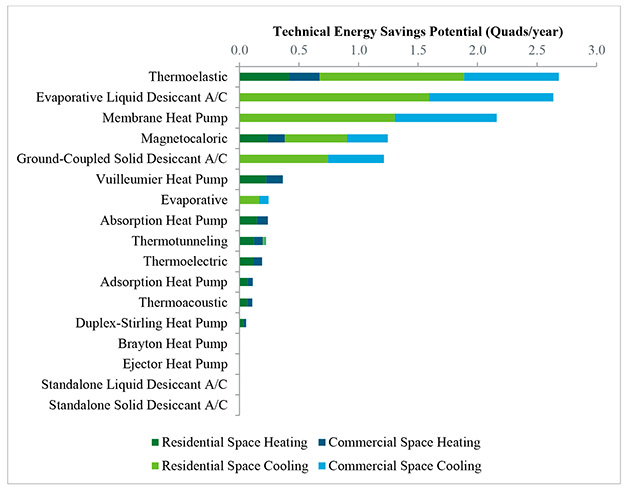
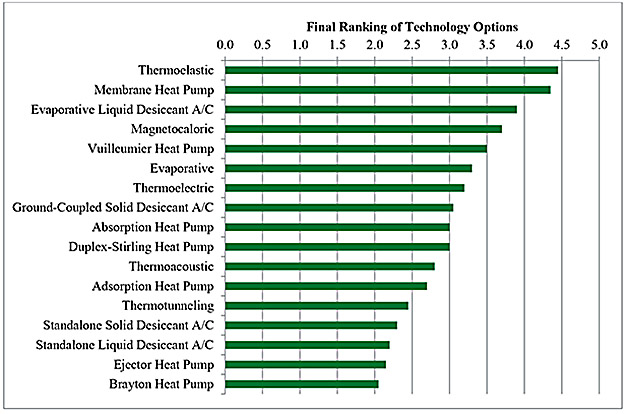
1. Thermoelastic
This technology is based upon the unique properties of shape-memory alloys (SMA). These alloys “remember” their original shape. When deformed they return to their pre-deformed shape when heated. Thermoelastic cooling systems stress and release a SMA core that absorbs heat from, or rejects heat to, its surroundings.
2. Membrane heat pump
Driven by a vacuum pump, advanced-membrane heat pumps provide cooling and dehumidification and/or heating and humidification by transferring moisture across a number of membranes.
3. Evaporative liquid desiccant ac
Evaporative liquid desiccant air conditioners consist of a primary channel that dries and cools incoming air using a liquid desiccant stream and a secondary channel that evaporatively cools a water layer using a portion of the dried air, thereby further cooling the supply air.
4. Magnetocaloric
Operates on the magnetocaloric effect, a phenomenon in which a paramagnetic material exhibits reversible temperature change when exposed to a changing magnetic field.
5. Vuilleumier heat pump
Similar to Stirling heat pumps, the Vuilleumier heat pump cyclically compresses and expands a gaseous working fluid between different volumes to produce a hot and cold side. With a high-temperature heat source, such as a gas burner, the system can generate space heating and cooling as well as water heating.
6. Evaporative cooling
Evaporative cooling systems use water to absorb sensible heat from airstreams, evaporating the water and thus cooling the air.
7. Thermoelectric
Under an applied voltage, thermoelectric materials generate a temperature difference that can provide space conditioning.
8. Ground-coupled solid desiccant ac
Ground-coupled solid desiccant ac technology combines two technologies: ground-coupled fluid systems and solid desiccants. The primary stage first dries the supply air using a solid desiccant wheel and the secondary stage sensibly cools the air using a ground-coupled fluid loop.
9. Absorption heat pump
Absorption systems use a refrigerant-absorbent working-fluid pair and thermal energy source to drive a heating and/or cooling cycle.
10. Duplex-Stirling heat pump
Duplex-Stirling heat pumps compress and expand a gaseous refrigerant to produce space conditioning by oscillating the working fluid between two chambers. The work for the Stirling heat pump cycle is provided by a piston shared with a Stirling engine.
11. Thermoacoustic
Thermoacoustic technology uses high-amplitude sound waves in a noble gas to pump heat.
12. Adsorption Heat Pump
Refrigerant vapor adheres to the surface (or within the structure) of specialised adsorbent materials. These materials release the vapour when heated to a high pressure and temperature, replacing a compressor in a heat pump cycle.
13. Thermotunnelling
Thermotunnelling technology is an advanced form of thermoelectric technology in which electrons are transmitted across a nanometer-scale vacuum via quantum tunnelling to produce cooling or heating.
14. Standalone solid desiccant ac
Desiccants are materials that have a high affinity for water, and can remove water from moist air when exposed to an airstream. In hvac systems, solid desiccant air conditioners absorb moisture from air to both dry and reduce the latent heat content of the incoming air, thereby cooling it.
15. Standalone liquid desiccant ac
Desiccants are materials that have a high affinity for water, and can remove water from moist air when exposed to an airstream. In hvac systems, liquid desiccant air conditioners (LDACs) absorb moisture from air to both dry and reduce the latent heat content of the incoming air, thereby cooling it.
16. Ejector heat pump
Ejectors accelerate and compress refrigerant using a secondary fluid pressurised by the additional of thermal energy.
17. Brayton heat pump
Brayton heat pumps generate usable heating and cooling by compressing and then expanding a gaseous working fluid, which is usually air.
The full report is available here