


Employing liquefied hydrogen as a cold energy source
24th June 2026JAPAN: A new heat exchange technology that employs liquefied hydrogen as a cold energy source for air conditioning and refrigeration equipment is being trialled in Japan.
Produced by liquefying hydrogen gas at an extremely low temperature of -253°C, liquefied hydrogen is suitable for large-scale transportation and storage. For this reason, it is used in industrial applications where transportation efficiency is required, as well as in hydrogen refuelling stations.
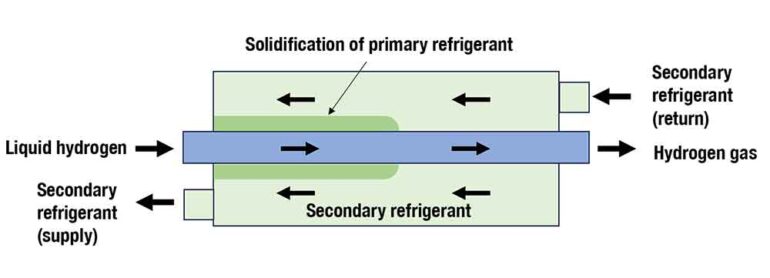
However, when using liquefied hydrogen, it is mainly returned to room-temperature hydrogen gas using a vapouriser. The cold energy generated in this process is currently released into the atmosphere.
Conventionally, heat exchange using the cold energy of liquefied hydrogen has presented challenges such as fluctuations in heat transfer performance and blockage of the flow path due to the solidification of the secondary refrigerant. During the heat exchange process, a portion of the secondary refrigerant – normally chilled water or brine – solidifies at the heat transfer surface, and hydrogen evaporates simultaneously.
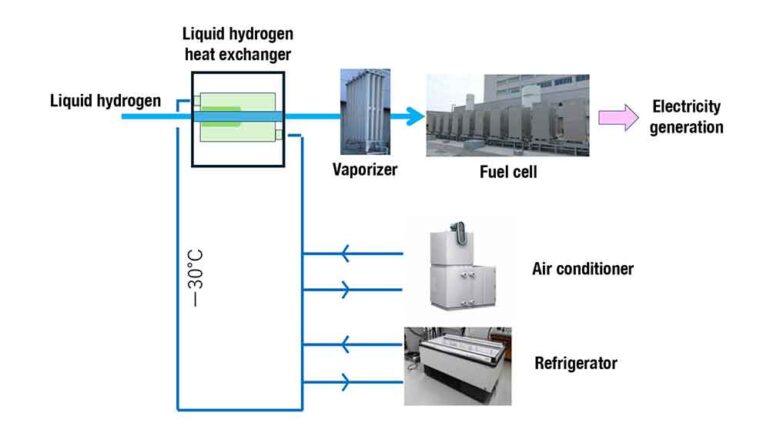
Since October 2022, two Japanese companies – Obayashi Corporation and Iwatani Corporation – have collaborated with Kansai University to study the heat transfer process in which boiling and solidification occur simultaneously.
Using this knowledge, Iwatani Corporation is said to have developed a heat exchange technology that can stably recover cold energy even when the secondary refrigerant solidifies.
It has been confirmed that recovering approximately 90% of the cooling energy obtained during the vapourisation process contributes to reducing electricity consumption for air conditioning. Going forward, the companies will continue to investigate methods for more effectively using cooling energy in a cascade system that sequentially uses different temperature ranges for cooling energy use, such as building air conditioning and refrigeration equipment.