


Müller trials zero-emission transport refrigeration
30th August 2023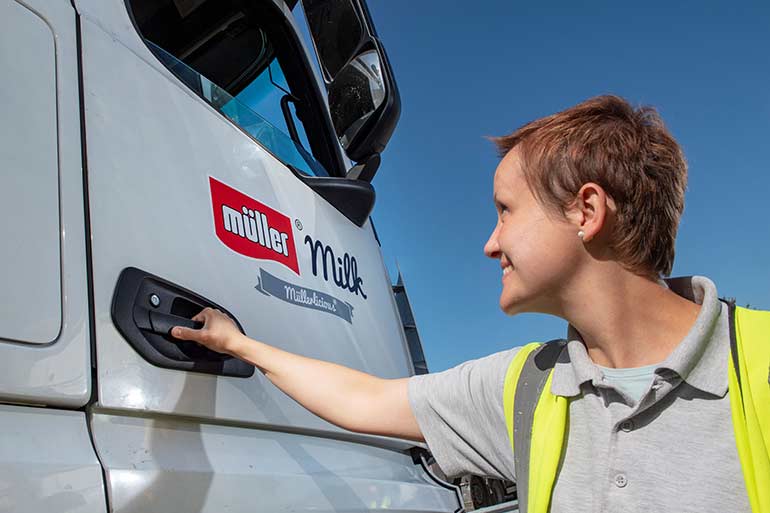
UK: Müller Milk & Ingredients is trialling solar panels and kinetic energy for its refrigerated trailers, as an alternative to refrigeration powered by diesel engines.
Part of the Müller UK & Ireland Group, owned by the German Müller family, the dairy company maintains service levels by operating logistics in-house.
In partnership with Sunswap, Müller Milk & Ingredients trialled the delivery of fresh milk using refrigerated trailers that are battery and solar-powered. 100% of the energy required came from free clean energy collected by the solar panels.
The business is also testing a refrigerated trailer system powered by kinetic energy in collaboration with Carrier Transicold. Carrier’s Vector eCool converts energy generated by the trailer axle and brakes into electricity, which is then stored in a battery pack to power the refrigeration unit.
It was found that, per trailer, the solar and battery-powered Sunswap system would eliminate all diesel, saving 3,700 litres and 9 tonnes of carbon every year. Carrier’s Vector eCool system would eliminate all carbon emissions associated with traditional refrigeration units operating with an auxiliary engine.
Following completion of the trials, Müller will consider further testing or a wider rollout throughout its network.
“We are unique in that the vast majority of our logistics operations are in-house, giving us the ability to work with our customers, and throughout the supply, to find the right solutions. As we look to deliver a better dairy future, we will continually innovate to reduce our impact,” said Müller Milk & Ingredients’ head of distribution Dan Hamby.
Related stories:
Vector eCool is first autonomous electric refrigerated trailer – 7 October 2020
FRANCE: Carrier Transicold has launched what it describes as the future of refrigerated trailer technology with a fully autonomous, all-electric engineless refrigerated trailer system. Read more…
£3m boost for all-electric transport refrigeration – 28 March 2022
UK: Sunswap, the London-based company offering a fully electric, zero-emission alternative to diesel-powered transport refrigeration units, has received £3m investment from the UK’s Clean Growth Fund and Barclays. Read more…
DFDS to deploy zero-emission refrigerated trailer – 11 October 2021
UK: Global shipping and logistics company DFDS is the first client for the zero-emission transport refrigeration system developed by London-based start-up company Sunswap. Read more…