



Scientists send heat energy through a vacuum
24th December 2019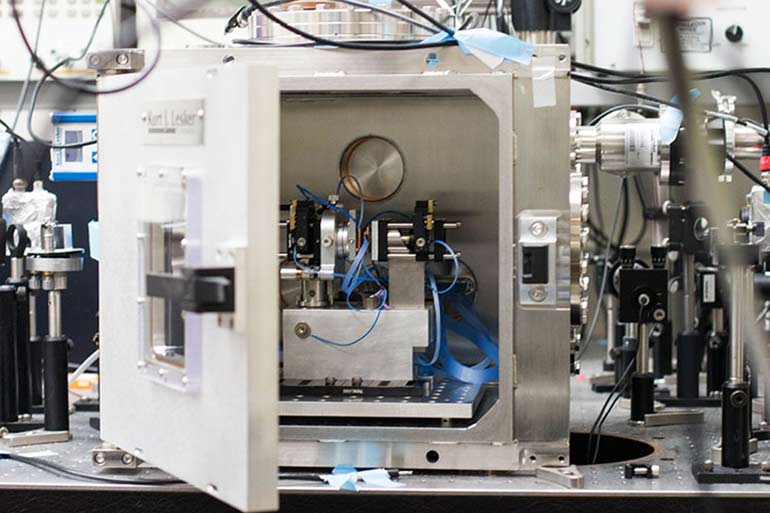
USA: Scientists in the US claim to have turned heat transfer physics on its head by proving that heat energy can travel through a vacuum.
It’s accepted that vibrations of atoms or molecules, which carry thermal energy, simply can’t travel if there are no atoms or molecules around. But a new study by researchers at the University of California, Berkeley, shows how the weirdness of quantum mechanics can turn even this basic tenet of classical physics on its head.
The study, published in the journal Nature, shows that heat energy can leap across a few hundred nanometers of a vacuum, thanks to a quantum mechanical phenomenon called the Casimir interaction.
Though this interaction is only significant on very short length scales, researchers say it could have profound implications for the design of computer chips and other nanoscale electronic components where heat dissipation is key.
“Heat is usually conducted in a solid through the vibrations of atoms or molecules, or so-called phonons — but in a vacuum, there is no physical medium. So, for many years, textbooks told us that phonons cannot travel through a vacuum,” said Xiang Zhang, the professor of mechanical engineering at UC Berkeley who guided the study. “What we discovered, surprisingly, is that phonons can indeed be transferred across a vacuum by invisible quantum fluctuations.”
In the experiment, Zhang’s team placed two gold-coated silicon nitride membranes a few hundred nanometers apart inside a vacuum chamber. When they heated up one of the membranes, the other warmed up, too — even though there was nothing connecting the two membranes and negligible light energy passing between them.
The feat was achieved because, according to quantum mechanics, there is no such thing as truly empty space.
King Yan Fong, a former postdoctoral scholar at UC Berkeley and the study’s other first author, explained: “Even if you have empty space — no matter, no light — quantum mechanics says it cannot be truly empty. There are still some quantum field fluctuations in a vacuum. These fluctuations give rise to a force that connects two objects, which is called the Casimir interaction. So, when one object heats up and starts shaking and oscillating, that motion can actually be transmitted to the other object across the vacuum because of these quantum fluctuations.”
“Because molecular vibrations are also the basis of the sounds that we hear, this discovery hints that sounds can also travel through a vacuum,” Zhang said.