


Toshiba introduces top performing VRF
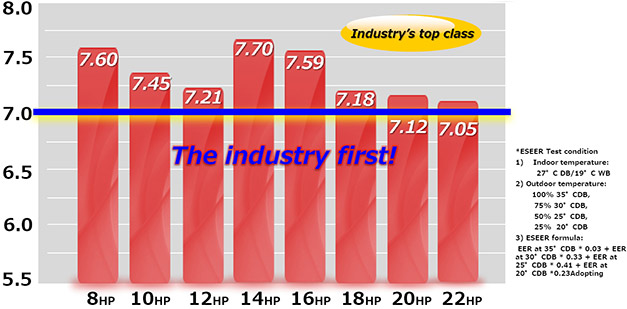
19th September 2015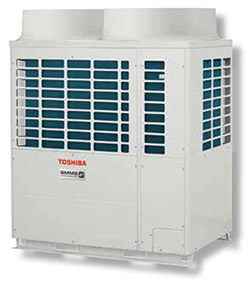 EUROPE: Toshiba’s new SMMS-e VRF conditioning system is said to set new standards for energy efficiency and performance, offering ESEER’s of over 7 across the range.
In addition to setting a new benchmark for energy efficiency, the new range also offers continuous heating and an innovative hands-free wireless commissioning system.
The high ESEER rating is possible due to developments in three core technologies – the compressor, heat exchanger and advanced intelligent control.
The Toshiba-designed twin rotary compressor, providing two-stage compression for improved efficiency and performance, remains at the heart of the new series. This latest version, however, includes a diamond-like carbon coating on the wear surfaces of all compression vanes, giving a significant increase in compressor rotation speed and resulting in a 50% higher displacement volume than previous generation of VRF systems.
The compressor also features the latest generation of Toshiba’s Infinity Variable Control, with the ability to adjust the compressor’s rotational speed in near seamless 0.1Hz steps.
The system’s heat exchanger has been completely redesigned, using smaller diameter tubes arranged in three rows in the coil, compared with two rows in the previous model. This is said to result in a 13% increase in surface area, further improving performance and efficiency.
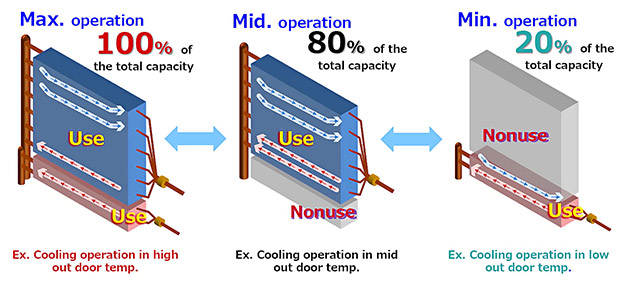
The capacity of the new generation heat exchanger, previously fixed, can now be adjusted to match the current load and ambient conditions. The new three-way variable heat exchanger enables the VRF’s control system to automatically select the optimum setting.
In maximum, all of the heat exchange capacity is used to deliver full cooling in high outdoor ambients. In the mid-range option, 80% of heat transfer capacity is employed in average outdoor temperatures. And in the lowest setting, just 20% of heat exchanger capacity is used to provide gentle operation when outdoor temperatures are low.
The SMMS-e also claims to break new ground in being able to provide continuous heating, with no requirement to stop during defrosts. This is made possible by the use of a new hot-gas bypass control, which simultaneously defrosts outdoor heat exchanger coils, while allowing the indoor unit to continue operating in heating mode.
On the controls front, a new approach to intelligent operation gives building occupants improved comfort and further enhances energy efficiency and reliability. SMMS-e uses intelligent flow technology, based on independent pulse motor valves to control the flow of refrigerant to each indoor unit. These deliver a carefully calibrated refrigerant flow to each indoor unit to create and then maintain optimum comfort conditions, based on the difference in temperatures detected by two sensors on each FCU.
This means that in the case of a distributed SMMS-e VRF system consisting of 64 indoor units there would be more than 300 individual sensors monitoring, controlling and optimising temperatures throughout the building.
For installers, Toshiba has developed what it is calling Wave Tool Technology, a wireless commissioning and performance validation tool which enables engineers to read and write data to the condensing unit using a smart phone. It enables testing and commissioning to be carried out without taking the covers off the unit.
It uses near field communication (NFC) to transmit data between the outdoor unit and the engineer’s smart phone. This tool allows service and commissioning engineers to instruct and obtain key system information, simply by touching their smart phone onto the NFC tag located on the outdoor unit.
With the new SMMS-e, it is now possible to connect up to 60hp in a single system, with up to 64 connectable indoor units, beating the previous 48hp maximum by a wide margin.
The SMMS-e is also available in a wider capacity range than ever before. On the smaller end of the scale, indoor units are now available in capacities of 0.6hp. Up the scale, outdoor units can offer up to 22hp on a single module platform, due to a newly developed chassis, reducing footprint, pipework and speeding up installation time.
Maximum total pipe work length for SMMS-e is 1000m, double the previous allowable length, with 235m now the maximum allowable distance between an outdoor unit and the farthest indoor unit.
A maximum of 40m between indoor units is enough to cover an entire 11-storey building, expanding the application envelope for Toshiba VRF to larger buildings.
The new compressor design and improved system controls has allowed the operating temperature range to be extended to -5ºC to 46ºC for cooling operation and -25ºC to 15.5ºC in heating mode.
The fan design in the outdoor unit has also been refined with a new profile and anti-eddy projections on the back of the fan to ensure smoother uninterrupted air flow and reduced noise. The outdoor fan motor also now incorporates a 3-phase motor.
Although only initially available in two-pipe, the launch of a three-pipe version is promised within the next six months.