



DEFRA’s F-gas decision is a delay, not a reprieve
10th July 2026
UK: Manufacturers’ group FETA has implored companies to continue prioritising lower-GWP refrigerants despite the delayed revision of Britain’s F-gas regulations.
“The delayed phasedown decision may have postponed a major regulatory change, but the direction of travel remains unchanged,” said FETA’s commercial manager Martyn Cooper,
“The transition away from higher-GWP refrigerants is continuing, and businesses that use this period to plan, invest and adapt will be best placed to navigate whatever policy framework emerges next.”
FETA’s message follows the Department for Environment, Food and Rural Affairs’ (DEFRA) announcement in May of a delay to its proposed F-gas phase down steps, admitting that it required “further work”.
While the EU revised its F-gas regulation in 2024, Great Britain still clings to the original 517/2014 regulation and phase down steps. Northern Ireland, under existing arrangements, continues to follow EU F-gas legislation, but stakeholders in England, Scotland and Wales are left waiting for a domestic policy direction.
“Since DEFRA published its review of the F-gas regulation in December 2022, businesses across the supply chain have been waiting to understand what the next phase of Great Britain’s hydrofluorocarbon phasedown strategy would look like,” Cooper says.
That wait finally ended in November when DEFRA launched a consultation on a revised GB HFC phasedown. This presented proposals to reduce the HFC quota from 31% of baseline levels to 16.2% from 1 January 2027, but did not address wider issues like product bans, servicing restrictions, or changes to training and certification requirements.
“For manufacturers, contractors, wholesalers and end users alike, such a sharp reduction raised concerns about supply chain resilience, refrigerant pricing, retrofit demand and the industry’s ability to transition at the required pace,” Cooper maintains.
“While the long-term objective of reducing reliance on higher global warming potential refrigerants is broadly accepted across the sector, the proposed timeline prompted questions about whether the market could realistically absorb such a dramatic shift without unintended consequences.”
FETA and its members argued for a more measured approach. The federation proposed a gentler reduction in quota levels during the 2027 and 2030 milestones, which it said would allow industry additional time to adapt while still delivering meaningful emissions reductions.
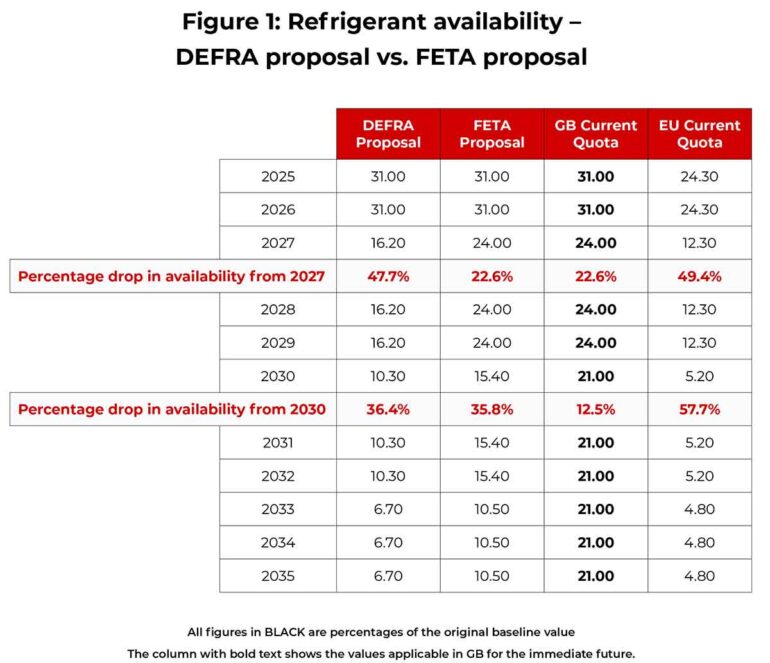
“The recommendation was designed to align more closely with DEFRA’s longer-term trajectory while avoiding a sudden supply shock in the late 2020s,” Cooper says.
DEFRA’s delay announcement surprised many observers, but the department concluded that further work was required before any final decisions could be made.
“At first glance, the announcement appears to be positive news,” Cooper insists. “Businesses have gained valuable time to prepare for future changes, review refrigerant strategies and continue investing in lower-GWP technologies. In a market already managing skills shortages, increasing heat pump deployment and evolving sustainability requirements, additional breathing space will be welcomed by many.
“However, there is a danger that the announcement could be interpreted as a pause in the transition. It is not. DEFRA has been clear that the existing GB F-Gas Regulation remains fully in force.”
Under current legislation, the HFC quota will still fall from 31% of baseline levels to 24% from 1 January 2027. Although less severe than the consultation proposal, this still represents a 22.6% reduction in refrigerant availability, a situation which FETA insists will create its own set of challenges for the market.
“The message for industry is therefore one of preparation rather than complacency,” FETA says. “Contractors and end users should continue prioritising lower-GWP refrigerants where technically and economically feasible. Equipment manufacturers must maintain investment in future-proof product portfolios, while wholesalers and service providers will need to manage the implications of tighter refrigerant availability and changing customer demand.
“Perhaps most importantly, stakeholders should remember that F-gas legislation extends far beyond quota allocations. Existing product bans and placing-on-the-market restrictions remain in force and will continue to shape technology choices across the RACHP sector.”
FETA insists that the delayed phasedown decision may have postponed a major regulatory change, but the direction of travel remains unchanged.
“The transition away from higher-GWP refrigerants is continuing, and businesses that use this period to plan, invest and adapt will be best placed to navigate whatever policy framework emerges next.”
FETA continues to lobby parliament and has been pushing for more detail and timelines.