


Car AC emissions could be cut by 60% annually
17th May 2026
USA: A new industry study claims that refrigerant emissions from automotive air conditioning systems in Europe could be reduced by around 60% annually by 2050.
The research, co-led by refrigerant producers Chemours and Solstice, was conducted by a technical working group looking at the whole vehicle lifecycle.
The report was initiated to support the authorities working on the PFAS restriction proposals. Led by the two refrigerant producers, the report was compiled with a technical working group comprising eight vehicle manufacturers, six tier 1 manufacturers, a garage chain, a distributor, and two end-of-life actors.
The objective was to quantify as an industry average the refrigerant emissions in mobile applications in the various stages of its lifecycle: refrigerant production, refrigerant delivery, vehicle first-fill, vehicle design, or emissions during the normal use of the vehicle, vehicle repair/accidents, vehicle service/repair, or the emissions related to the service and repair process (not the refrigerant used to recharge the system during maintenance), vehicle end of life, and refrigerant reclamation.
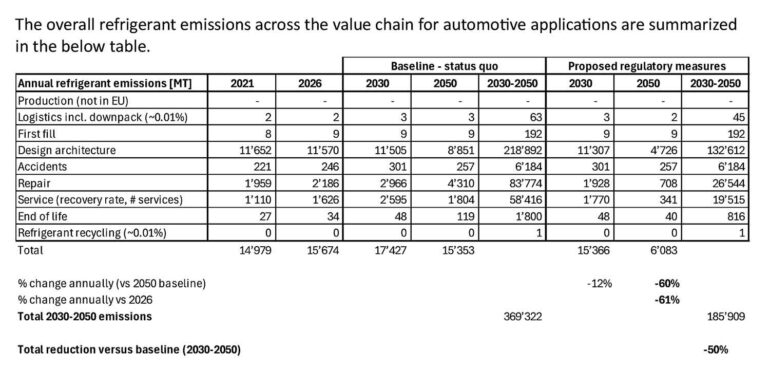
Through coordinated measures implemented across the full automotive value chain, it was found that the refrigerant emissions could be reduced from 14,979Mt annually in the 2021 baseline to 6,083Mt in 2025. An average of half of the cumulative emissions could be avoided between 2030 and 2050.
The group found that the largest emissions, by far, were from automobile refrigerant leaks. These are primarily linked to several key controllable factors such as component wear, ageing seals and condenser damage caused by corrosion or road debris. The group also found that emissions are driven less by refrigerant choice than by how effectively leaks are prevented, detected and repaired over a vehicle’s lifetime.
“This means the biggest opportunity for emissions reductions lies in improving how systems are maintained and how refrigerants are recovered at the end of vehicle life,” commented Julien Soulet, vice president and general manager of Solstice Refrigerants and Applied Solutions.
“Using economical solutions that are already available today, the group found that Europe has a major near-term opportunity to achieve large-scale emissions reductions of automobile refrigerants from light vehicles.”
Because automobile refrigerant emissions are primarily seen in older and often poorly maintained systems, the working group concluded that targeted measures such as early leak detection and timely repair can help to minimise vehicle refrigerant emissions. Addressing leaks early helps avoid repeated recharging and slows system deterioration while improving reliability and extending component life.
“Practical and simple actions such as including air-conditioning system inspections in vehicle inspections that already happen across Europe and improved servicing practices can help reduce emissions by preventing gradual refrigerant loss,” Soulet added. “In addition, improving refrigerant recovery during servicing and at end of life can help further reduce emissions by preventing releases into the atmosphere and enabling reuse.”
With investments being offset by longer component lifetimes and avoided repair costs, there is predicted to be no cost impact for consumers.
The study’s recommendations are said to be ready for rapid adoption across both conventional combustion engine and electric vehicles, supporting the shift toward a circular economy including end-of-life management through reclamation and recycling programmes.
According to the report compilers, these actions are underpinned by broad collaboration across the automotive value chain, paving the way for measurable progress in environmental sustainability and industry best practices.
The report – Lifecycle Refrigerant Emissions from Automotive Air Conditioning Systems in the
European Union – can be downloaded here.