


Nano technology brings major advance in thermoelectrics
22nd May 2025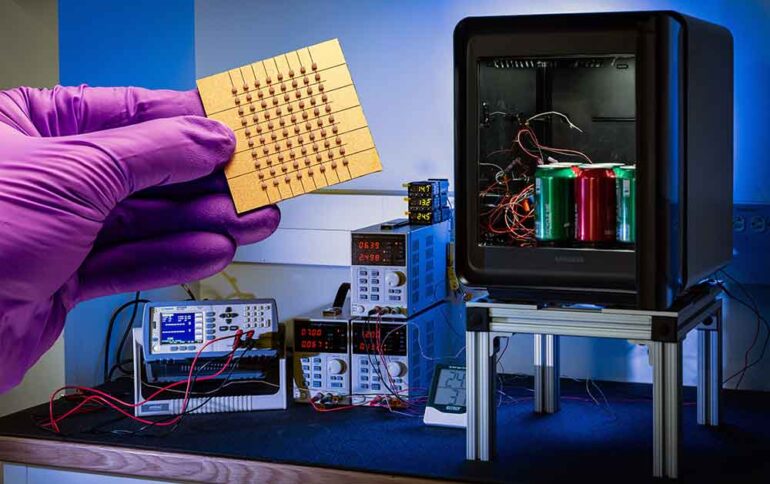
USA: Researchers in the US claim to have developed an easily manufacturable solid-state thermoelectric refrigeration technology that is twice as efficient as similar devices.
This advancement, using nano-engineered materials, is said to offer a scalable alternative to traditional compressor-based refrigeration.
In a paper published in Nature Communications, a team of researchers from the Johns Hopkins Applied Physics Laboratory (APL) in Laurel, Maryland, and refrigeration engineers from Samsung Research, demonstrated improved heat-pumping efficiency and capacity in refrigeration systems.
The increased efficiency is attributed to high-performance nano-engineered thermoelectric materials invented at APL known as controlled hierarchically engineered superlattice structures (CHESS).
The CHESS technology is the result of 10 years of APL research in advanced nano-engineered thermoelectric materials and applications development. Initially developed for national security applications, the material has also been used for non-invasive cooling therapies for prosthetics and won an R&D 100 award in 2023.
“This real-world demonstration of refrigeration using new thermoelectric materials showcases the capabilities of nano-engineered CHESS thin films,” said Rama Venkatasubramanian, principal investigator of the joint project and chief technologist for thermoelectrics at APL. “It marks a significant leap in cooling technology and sets the stage for translating advances in thermoelectric materials into practical, large-scale, energy-efficient refrigeration applications.”
Thermoelectric refrigeration cools by using electrons to move heat through specialised semiconductor materials, eliminating the need for moving parts or refrigerants.
Bulk thermoelectric materials are used in small devices like mini-fridges, but their limited efficiency, low heat-pumping capacity and incompatibility with scalable semiconductor chip fabrication have historically prevented their wider use in high-performance systems.
In the study, researchers compared refrigeration modules using traditional bulk thermoelectric materials with those using CHESS thin-film materials in standardised refrigeration tests, measuring and comparing the electrical power needed to achieve various cooling levels in the same commercial refrigerator test systems.
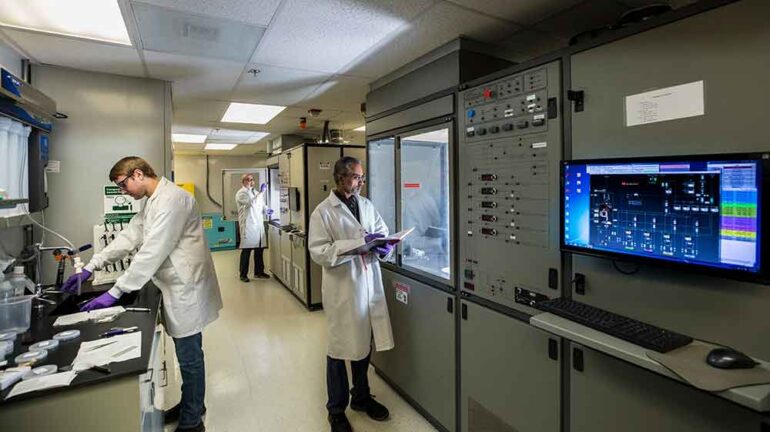
The refrigeration team from Samsung Research’s Life Solution Team collaborated with APL to validate the results through detailed thermal modelling, quantifying heat loads and thermal resistance parameters to ensure accurate performance evaluation under real-world conditions.
Using CHESS materials, the APL team is said to have achieved nearly 100% improvement in efficiency over traditional thermoelectric materials at room temperature (around 25ºC). They then translated these material-level gains into a near 75% improvement in efficiency at the device level in thermoelectric modules built with CHESS materials and a 70% improvement in efficiency in a fully integrated refrigeration system, each representing a significant improvement over state-of-the-art bulk thermoelectric devices. These tests were completed under conditions that involved significant amounts of heat pumping to replicate practical operation.
Built to scale
Beyond improving efficiency, the CHESS thin-film technology uses remarkably less material — just 0.003 cubic centimeters, or about the size of a grain of sand, per refrigeration unit. This reduction in material means APL’s thermoelectric materials could be mass-produced using semiconductor chip production tools, driving cost efficiency and enabling widespread market adoption.
“This thin-film technology has the potential to grow from powering small-scale refrigeration systems to supporting large building HVAC applications, similar to the way lithium-ion batteries have been scaled to power devices as small as mobile phones and as large as electric vehicles,” Venkatasubramanian said.
These materials and devices continue to show promise for a broad range of energy-harvesting and electronics applications in addition to the recent advances in refrigeration. APL plans to continue to partner with organizations to refine the CHESS thermoelectric materials with a focus on boosting efficiency to approach that of conventional mechanical systems. Future efforts include demonstrating larger-scale refrigeration systems, including freezers, and integrating artificial intelligence-driven methods to optimise energy efficiency in compartmentalised or distributed cooling in HVACR equipment.