


Unqualified work linked to fatal ammonia leak
29th January 2023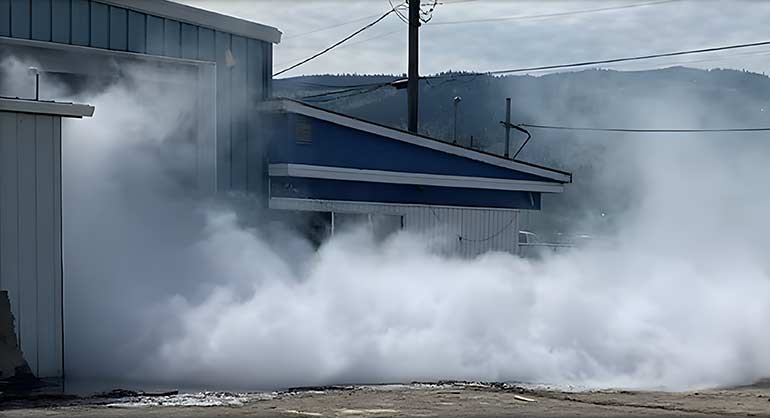
CANADA: A Canadian safety authority is urging systems operators to employ licensed refrigeration contractors when carrying out work on ammonia systems following a fatal leak last year.
The incident occurred during the dismantling of a refrigeration system at the Arctic Glacier ice facility in Kamloops, British Columbia. The report by independent safety organisation Technical Safety BC describes the release of a “significant amount” of ammonia, resulting in the death of one facility employee and the hospitalisation of three other workers. Neighbouring businesses were also affected by the release and were evacuated. Fourteen additional persons experienced respiratory problems from ammonia inhalation.
The primary cause of the incident was found to be a failure to remove ammonia from the refrigeration system ahead of its disassembly. Although no qualified refrigeration mechanic was present during the disassembly, those carrying out the work understood the system had been previously emptied.
“Our safety system is built on the foundation of ensuring that work associated with hazards is only completed by persons with the necessary skills and knowledge,” said Jeff Coleman, Technical Safety BC’s director, technical programmes.
Misunderstanding
On May 26, 2022, a crew was in the process of cutting up and disassembling two separate ammonia refrigeration systems, referred to as P24 and P34 in the report, that had been shut down in 2015.
Those present understood that ammonia had been previously removed from both systems. During the removal of a section of the P34 system containing a receiver and compressor, a valve handle protruding past the frame was identified as a potential cause of issues with the rigging process.
One of the individuals turned the valve handle, resulting in a large release of ammonia. The individual who turned the handle was sprayed by the ammonia and moved further into the building. The remaining members of the crew evacuated through a nearby open bay door. The individual who opened the valve was extracted from the building and pronounced dead following the incident.
“Leading up to the incident, workers unfamiliar with ammonia relied on the guidance of previously qualified refrigeration mechanics. This resulted in the work continuing when it likely would have otherwise been stopped,” the report states.
“The safe dismantling of an ammonia system requires that the system be assessed, and ammonia and oil be removed prior to any disassembly work. Removal of ammonia and oil from a refrigeration system is regulated work that requires the knowledge and skills that a licensed contractor brings with qualified refrigeration mechanics,” it adds.
Previous release
There had already been an ammonia release the day before the fatal incident when one of the riggers released ammonia while cutting a pipe during the disassembly of the separate P24 system.
Despite those present concluding that there were only “residual” amounts of ammonia remaining, the subsequent purging into the parking lot is thought to have lasted for approximately 16.5 hours.
Even after the purging occurred Technical Safety BC’s investigation found that approximately 100lbs (45kg) of liquid ammonia was still present in the P24 system.
Additionally, the P34 receiver was visually assessed, and incorrectly concluded to not contain ammonia.
In all, between May 25 and May 26, up to 1000lbs (454kg) of ammonia was dissolved into water and released directly into the facility parking lot from the P24 system.
During the fatal incident on May 26, 2022, between 1345lbs (610kg) and 1600lbs (726kg) of ammonia was released as a vapour directly into the atmosphere from the P34 system.
“Only those with the necessary skills and knowledge should be conducting activities with hazardous work,” Technical Safety BC says. “This principle applies throughout the life cycle of regulated systems, including the stage of dismantling and decommissioning. Licensed contractors must validate that ammonia and oil have been removed from a system and that equipment is ready for disassembly and transportation.”
The full report is available here.
Related stories:
One dead in ammonia leak – 27 May 2022
CANADA: One person has died after an ammonia leak yesterday at an ice-making plant in British Columbia. Read more…