


Bespoke Toshiba VRF calms Crossrail
28th February 2018
UK: A bespoke VRF air conditioning system has been developed for the Crossrail project to provide high resilience cooling for its new underground facilities.
Crossrail is a 118km railway line which will run through parts of London and the home counties of Berkshire, Buckinghamshire and Essex. The first section of Crossrail – between Paddington and Abbey Wood – is due to open in December.
The bespoke air conditioning system was developed by a project team comprising representatives from Toshiba Air Conditioning UK and Crossrail engineering staff, which provided the solution for contractor Laing O’Rourke. It will be used to provide a temperature-controlled environment in ticket halls, station control centres and equipment rooms.
London Underground’s strict fire safety requirements, and a need to integrate refrigerant leak detection and management systems, were particular challenges of the project. A fine control of temperatures was also required, along with low power draw on equipment start-up.
The development team carried out a detailed evaluation of all components in Toshiba’s indoor units. As London Underground’s fire-prevention code places strict limits on the use of plastics below ground, the standard drain pan was replaced with a metal version, and several other components – such as fans, motors, controls and insulation – were replaced with non-plastic alternatives.
The system is equipped with Toshiba’s new integrated LD2 refrigerant leak detection and management technology, which constantly monitors refrigerant charge in relation to performance. In the unlikely event of a leak, it sends an alarm signal and automatically isolates the site of the leak, preventing further loss.
Low power draw on start-up is ensured by the use of Toshiba’s inverter system, which allows the system to be controlled in increments of just 0.1Hz.
With the use of Toshiba’s twin rotary compressors, this also enables the system to operate at very low loads, when cooling demand is low. This suits the demand profile of the equipment rooms in which the systems are installed, which was a focus of Crossrail’s engineering team. The equipment was tested and certified to CE standard at a third party facility.
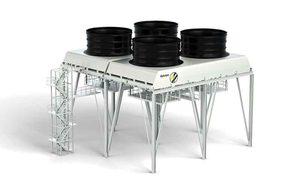
The VRF condensing units in the Crossrail project connect to bespoke floor/wall-mounted and ceiling-suspended indoor units. Toshiba is supplying some 30 of the specialist units to Laing O’Rourke, to be installed by contractors Conair UK and Skyline Air Conditioning.