


Hidden costs of an inefficient refrigeration system
12th July 2019
Based on a study conducted by Star Refrigeration, the Glasgow-based company’s operations service manager, Chris Druce, looks at the effect that refrigerant leakage can have on plant running costs.
A refrigeration system’s efficiency is influenced by a number of factors but a significant, and often overlooked, hidden cost of running a refrigeration plant is refrigerant leakage.
It’s estimated that some refrigeration systems have the potential to lose more than 20% of their charge each year through poor design, quality of construction and lack of good maintenance. This results in increased energy consumption, elevated carbon footprint and higher operating costs (energy and service).
So how much is it costing refrigeration users to run inefficient plants in these often ‘hidden’ running costs? In a study carried out by Star Refrigeration for the Institute of Refrigeration, the refrigerant charge within a system was reduced by increments of 2%, 6.5% and 11% to simulate the low, medium and high leakage rates that could be realistic in the field. The graphs below illustrate the operating costs for the same system at these leakage rates based upon the kWh readings taken and a declared average of £0.13/kWh.
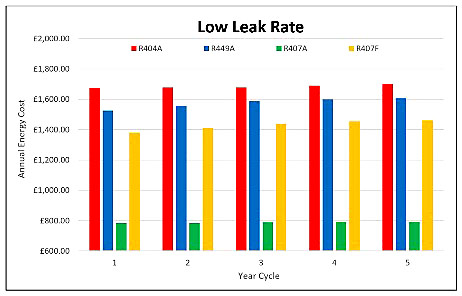
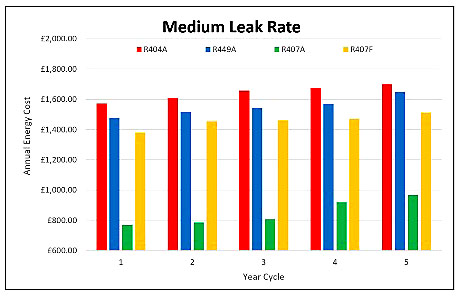
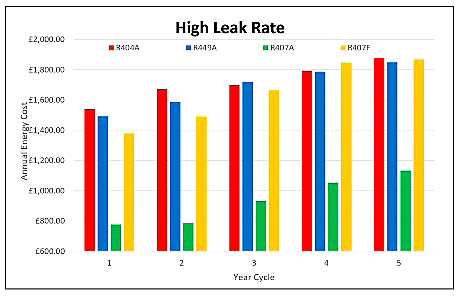
The graphs demonstrate at all leakage rates that R404A was the refrigerant that returned the highest average operating cost whereas the lowest annual energy cost for all leakage rates was R407A.
Environmental impact of direct and indirect emissions
The environmental impact of a refrigeration system is a summation of its direct and indirect emissions. Direct emissions come from leakage of refrigerant from the system to the atmosphere and are a factor of the quantity released and the refrigerant’s global warming potential (GWP). Choosing a low GWP refrigerant and having a well maintained system helps to minimise direct emissions. Indirect carbon emissions come from the generation of power necessary to run the system including motors, fans and other electrical equipment. This electrical energy is generated at a power station or locally and has its own carbon emissions per kWhr. Ensuring optimised performance keeps power requirement and therefore emissions at the generation source to a minimum and avoiding leakage is key to this too.
Although swapping to a low GWP refrigerant can make a difference to carbon emissions, only 20% of the plant’s total carbon emissions are direct. Indirect emissions account for 80% of the total, which demonstrates the significance of ensuring a refrigeration system is operating as efficiently as possible through design and maintenance.
For this reason, it pays to look after your equipment from a leakage perspective. The energy costs from running a system which is losing refrigerant (and therefore operating inefficiently) often outweighs the cost of maintaining and repairing the system.
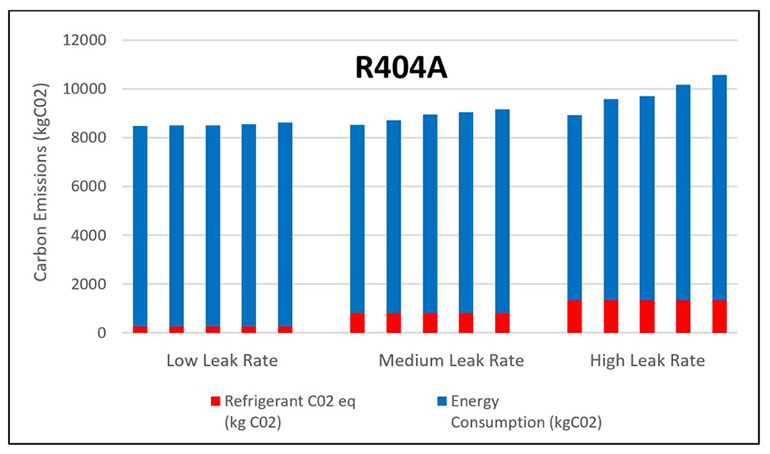
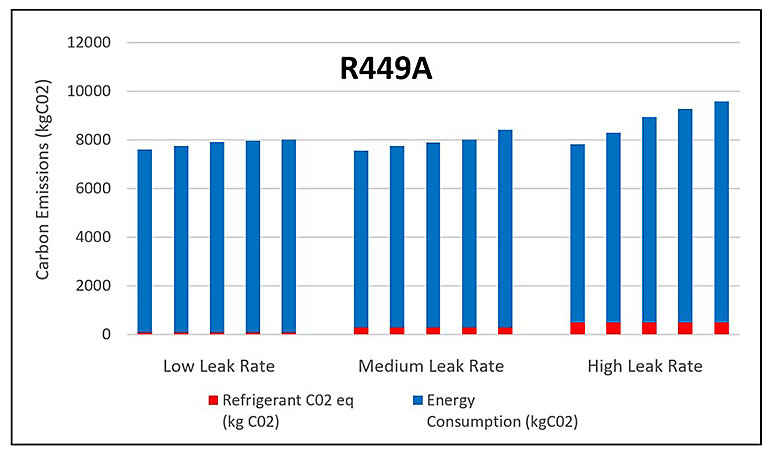
The study carried out by Star Refrigeration assessed the effects of refrigerant leakage on both direct and indirect carbon emissions using the high GWP refrigerant R404A. This data was compared with alternative refrigerants including R449A, R407A and R407F. It was demonstrated that significant capacity and efficiency reductions could be seen for each refrigerant when undercharged. At design conditions, R407A measured the highest capacity and efficiency whereas the lowest was found to be R404A. Reducing the refrigerant charge to 50% showed that R449A operated with the highest capacity and efficiency with R407A becoming the lowest.
Leakage rates
Much in the same way that an MOT and service can reduce repair costs for your car, a maintenance package is a preventative measure for your refrigeration plant. The initial design of the plant and choice of refrigerant are also contributing factors to the annual energy bill and the associated carbon footprint so it is important to consider these when selecting new equipment.
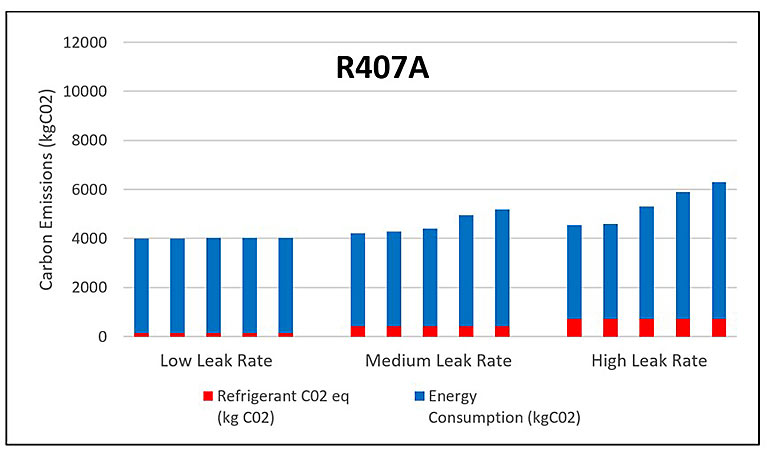
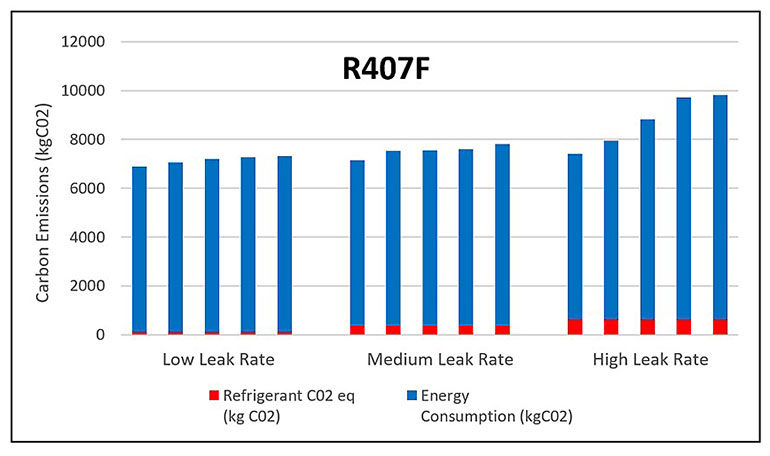
Looking at the graphs below, the differences between both the direct and indirect carbon emissions of the same system when retrofitted with modern replacements can be seen. The graphs illustrate the effect that the same leakage rates have on the carbon emissions showing that in all cases, an increase when charge levels are reduced.
HFC phase down – what next?
Due to the F-gas Regulations, the use of high GWP value refrigerants will be banned in new equipment from 2020 and a ban on the use of virgin refrigerant with a GWP exceeding 2,500 will also coming into place for servicing existing systems.
One of these gases is R404A and the 2020 phase-out has caused price increases and refrigerant shortages as end users attempt to stock up for the future. It has a total global warming potential (GWP) of 3922, which means for every kilogram of R404A released into the atmosphere, the equivalent emissions of CO2 is 3922 kg. The industry has to be responsible for its total carbon footprint and there are many other alternatives available that are less harmful and have a less significant impact on the environment.
Financial costs
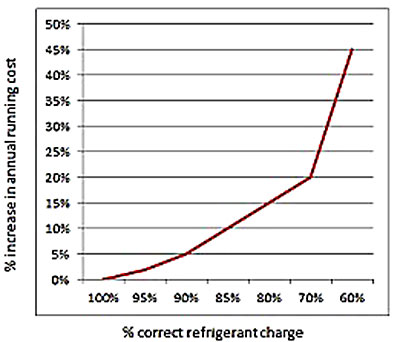
The financial implications of refrigerant loss on indirect operational costs are considerable. The graphic below shows that at 70% refrigerant charge, an increase of almost 20% can be seen on operational costs.
Options for replacing R404A
Refrigerant leakage is always bad for the environment, but certain refrigerants are worse than others that is why there is a GWP scale. The British Standards Institution defines the GWP as “an index describing the radiative characteristics of well-mixed greenhouse gases, that represent the combined effects of the differing times these gases remain in the atmosphere and their relative effectiveness in absorbing outgoing infrared radiation. This index approximates the time integrated warming effect to a given greenhouse gas in today’s atmosphere, relative to CO2”.
With time running out for R404A and other high GWP refrigerants, it’s important that end users of these refrigeration systems look at options for the future. Business owners have a number of options:
- Retrofit their plant to be able to use a currently preferred F-gas refrigerant alternative
- Invest in a new system with lower GWP refrigerant which has a longer life expectancy under F-gas
- Invest in a new future-proof plant that uses a natural refrigerant such as CO2 or ammonia, both with little or no GWP.
It may not be financially viable to completely replace the refrigeration system and so we have identified three retrofit gases that are suitable for existing plants:
R449A
A zeotropic blend with non-toxic and non-flammable properties. R449A has a GWP of 1397, a reduction of 64.4% compared to R404A. Suitable for low to medium temperature applications.
R407A
A zeotropic blend that is suitable for both low and mid temperature applications.
R407A has a GWP of 2107 and a similar energy performance, offering the same output as R404A with a 46.3% reduction on GWP
R407F
Another non-toxic, non-flammable zeotropic blend. The GWP of 1825 offers a 53.3% reduction on R404A.
All three of these refrigerant have a temperature glide which means the refrigerant temperature changes during evaporation and condensation. Before carrying out any retrofit works, we recommend that the system is assessed by a competent contractor or consultant to ensure it is suitable for operating with these refrigerants.
More energy efficient and economical refrigeration
Refrigerant leakage is a significant and often overlooked hidden cost of running a refrigeration plant. The prices of HFCs are rising sharply, which is another reason to ensure the system is free from leaks; the cost of high GWP refrigerants increased by more than 1000% in recent years. There is a shortage of supply of these refrigerants, so end users need to decide how to continue to cool their business assets.
A leaking system is literally leaking money but don’t forget that the energy efficiency of the plant will also impact its carbon emissions and the cost of the energy bills. Repairing refrigeration plants and investing in low GWP refrigerants will often work out less overall than the cost of running an inefficient plant for years and years.