


Cooling paint also harvests water
17th November 2025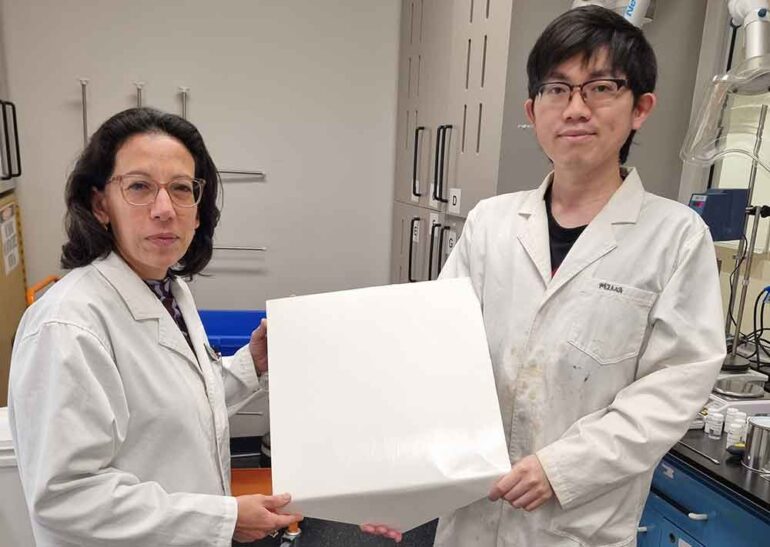
AUSTRALIA: A nano-engineered polymer paint-like coating developed by researchers in Australia is said to be able to passively cool buildings and capture water directly from the air.
While cooling paints are not new, the development by researchers at the University of Sydney and start-up Dewpoint Innovations could help cool buildings, while also tackling water scarcity.
The research team led by Professor Chiara Neto created a porous polymer coating that reflects up to 97% of sunlight and radiates heat into the air, keeping surfaces up to six degrees cooler than the surrounding air even under direct sun. This process creates ideal conditions for atmospheric water vapour to condense into droplets on the cooler surface.
Professor Neto from the University of Sydney Nano Institute and School of Chemistry said the findings could have far-reaching implications.
“This technology not only advances the science of cool roof coatings but also opens the door to sustainable, low-cost and decentralised sources of fresh water – a critical need in the face of climate change and growing water scarcity,” she said.
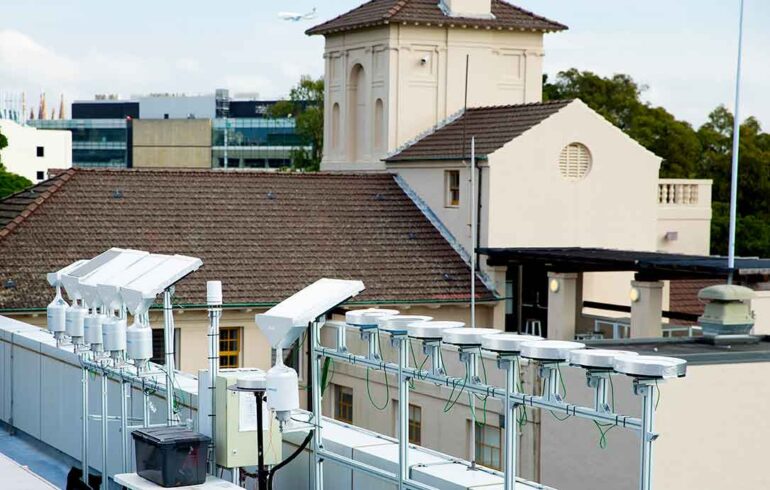
In a six-month outdoor study conducted on the roof of the Sydney Nanoscience Hub, dew could be collected over 32% of the year and so could provide a sustainable and predictable supply of water even in periods with no rain. Under optimum conditions, the coatings can harvest up to 390ml/m2 of water per day.
The study, published in Advanced Functional Materials, shows that passive cooling and atmospheric water capture can be integrated into a paint-like material for large-scale use.
Unlike traditional white paints, the porous coatings, made of PVDF-HFP, do not rely on UV-reflective pigments such as titanium dioxide.
“Our design achieves high reflectivity through its internal porous structure, delivering durability without the environmental drawbacks of pigment-based coatings,” said Dr Ming Chiu, the study’s lead author and CTO of Dewpoint Innovations.
“By removing UV-absorbing materials, we overcome the traditional limit in solar reflectivity while avoiding glare through diffuse reflection. This balance between performance and visual comfort makes it easier to integrate and is more appealing for real-world applications.”
Professor Neto maintains that the study also challenges the assumption that dew collection only works in humid climates. “While humid conditions are ideal, dew can form even in arid and semi-arid regions where night-time humidity rises. It’s not about replacing rainfall but supplementing it – providing water where and when other sources become limited.”
To bring the discovery from the lab to rooftops, Dewpoint Innovations is now developing a water-based paint formulation that can be applied using ordinary rollers or sprayers.
With more than two million Australian homes already collecting rainwater, Professor Neto said dew-collecting roofs could complement existing systems.
The Neto group’s innovation was licensed from the University of Sydney in 2022 to start-up company Dewpoint Innovations.