


Poor install makes ac biggest fire risk
12th July 2015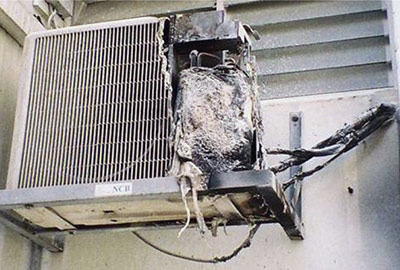 SINGAPORE: Air conditioning units are reported to pose a greater fire risk than any other common household appliance in Singapore.
A new report from the Singapore Civil Defence Force (SCDF) says that its fire-fighters, rescue and emergency medical services deal with about 2-3 cases per month. In 2014, there were 29 reported cases.
Poor installation and bad wiring practices are said to be major contributory factors. The SCDF maintains that proper installation of the air conditioning system is the critical first step in the prevention of fires.
A prominent root cause of the fires is blamed on the use of intermediate connections, by means of twisting wires together and insulating them with electrical tape, within the fan coil unit. Such a technique for creating an electrical splice is said to be widely practised in Singapore but can be problematic especially when it is applied in FCUs.
Described as a flagrant violation of both regulation and good sense, the SCDF says the use of such splices in FCUs may greatly heighten fire risk, particularly when water from condensation is involved.
Air conditioning has grown considerably amongst Singapore’s population of 5.3 million. From an ownership of 58.3% among Singapore households in 1998, this figure grew to 76.1% in 2013.
A fire in the indoor fan coil unit was found to be responsible for 44.2% of all residential air conditioning system fires and, predictably, was most likely to result in substantial property damage. The condensing unit was the source of 42.6% of all residential air conditioning system fires between 2008 and 2014 but these were largely localised with no potential of extensive fire spread due to their outside location. Significantly, 26.4% of all FCU fires involved units in standby mode.
Burn tests showed that the plastic cover of the FCU would melt and drip, potentially start a secondary fire with any combustible material underneath. Of the 87 reported FCU fires from 2008 –2014, 73.6% were localised to the FCU while 26.4% spread to other parts of the room following the development of a secondary fire.
It is known that dust or contamination in the airflow path can settle over electrical components and cause tracking faults leading to a high-resistance fault that could ignite nearby combustible materials. Excessive temperature rise can also occur in compressor and fan motors due to bearing friction, increase in load or capacitor degradation. Motor capacitors can develop internal resistance over time and can cause sufficient heating to self ignite if encased in plastic.