



Sustainable cooling could slash emissions
13th November 2025
BRAZIL: Global cooling demand could more than triple by 2050 without the adoption of sustainable technology, according to a new report by the UN Environment Programme (UNEP).
It is claimed that the Sustainable Cooling Pathway, presented by UNEP at this week’s COP30 in Belém, Brazil, could reduce emissions by 64% – 2.6 billion tons of CO2e – below the levels expected in 2050, protecting three billion people from rising heat, and saving up to US$43 trillion in avoided electricity and infrastructure costs.
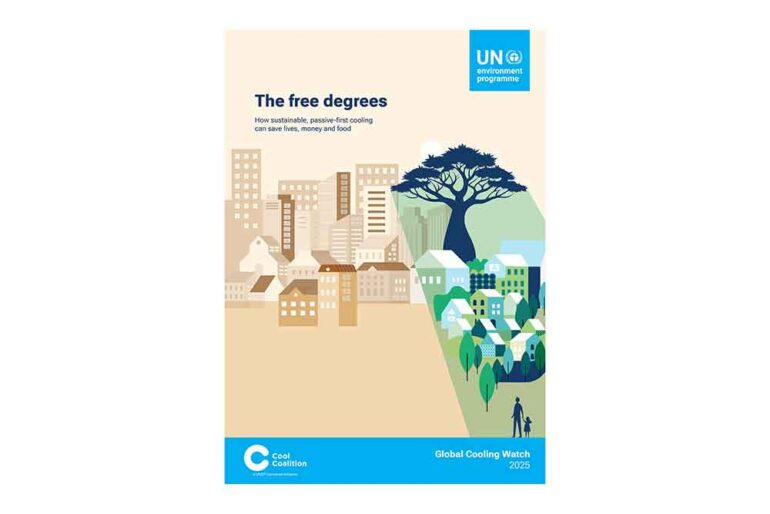
The report, The Free Degrees, finds that cooling demand could more than triple by 2050 under business as usual, driven by increases in population and wealth, more extreme heat events and low-income households increasingly gaining access to more polluting and inefficient cooling.
This would almost double cooling-related greenhouse gas emissions over 2022 levels – pushing cooling emissions to an estimated 7.2 billion tons of CO2e by 2050 – despite efforts to improve energy efficiency, phase down climate-warming refrigerants and overwhelm power grids during peak load.
“As deadly heat waves become more regular and extreme, access to cooling must be treated as essential infrastructure alongside water, energy and sanitation,” said Inger Andersen, Executive Director of UNEP. “But we cannot air condition our way out of the heat crisis, which would drive greenhouse gas emissions higher and raise costs. Passive, energy efficient and nature-based solutions can help meet our growing cooling needs and keep people, food-chains and economies safe from heat as we pursue global climate goals. We have no excuse: it is time we beat the heat”.
The report maintains that the sustainable cooling pathway can provide access to space cooling or refrigeration, resilient buildings and urban green spaces to all, including low-income and vulnerable groups, without exacerbating the climate crisis.
This would be achieved by combining passive cooling strategies, low-energy and hybrid cooling that combines fans and air conditioners, rapid adoption of high-efficiency equipment and accelerated phase-down of HFC refrigerants under the Kigali Amendment.
It urges passive and low-energy solutions to be embedded in national policies and urban planning. Such solutions, the report claims, are also highly affordable and critical for improving access to cooling. If adopted, the pathway could save US$17 trillion in cumulative energy costs through to 2050 and avoid up to US$26 trillion in grid investment through reduced electricity demand.
These measures underpin the Beat the Heat implementation drive – a collective effort led by the Brazil COP30 presidency and UNEP Cool Coalition – to localise the Global Cooling Pledge and bridge gaps in policy, finance and delivery of heat resilience and urban cooling. Today, over 185 cities from Rio de Janeiro to Jakarta to Nairobi and 83 partners have joined Beat the Heat, alongside the 72 Global Cooling Pledge signatories.
Some 72 nations have joined the Global Cooling Pledge since its launch at the UN Climate Change Conference (COP28) in Dubai in 2023. Those nations pledge to reduce cooling-related emissions by 68% by 2050.
As of mid-2025, 29 countries had established specific greenhouse gas reduction targets for the cooling sector, with a further five developing such targets. In total, 134 countries have incorporated cooling into their Nationally Determined Contributions (NDCs), National Adaptation Plans (NAPs), Long-term Low Emission Development Strategies (LT-LEDS), energy plans, or other national climate strategies.
However, UNEP reports that only 54 countries have comprehensive policies across all three priority areas for cooling: passive cooling in building energy codes, minimum energy performance standards, and refrigerant transition. A further 78 countries cover two of these pillars, 40 cover only one, and 20 have yet to begin.
The largest gaps are in African and Asia-Pacific countries, where much of the global rise in demand for cooling can be expected.
The report issues a series of recommendations to increase action, including moving from emergency response mode to proactive, multi-level governance on extreme heat and cooling, treating heat protection and cooling as a public good, and prioritising passive and nature-based solutions, including urban design, to cut cooling loads, mitigate the urban heat island effect and reduce grid stress.