


Skills gap: the answer’s already on the van
3rd May 2026

Will Overton, director of Vectis Refrigeration and founder of the Wisdom Group FM, argues that the skills gap in refrigeration and HVAC is not a training problem: it is a knowledge capture problem. He maintains that the answer to the industry’s biggest challenge is already sitting in every service van in the country.
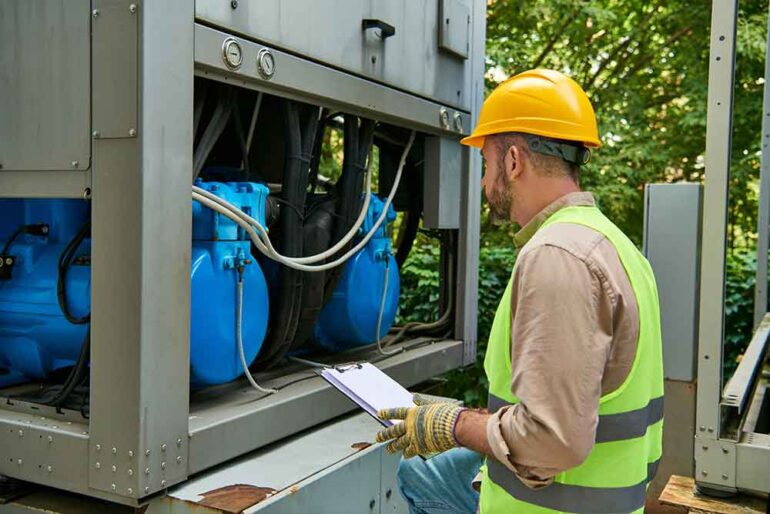
Two engineers attend the same callout. A walk-in cold room on a retail site, alarms going off. The junior opens the manual and starts checking the obvious, compressor contactor, HP and LP switches, fan motors. Forty five minutes in, he is still chasing readings. The senior walks in, listens for six seconds, checks one valve, and has the system running in twelve minutes.
Nothing about that twelve minute fix was written down. No one recorded what the senior heard, what he ruled out in his head before he even opened his tool bag, or why he went straight to that valve. The junior watched it happen and still could not tell you why.
That gap, between watching a fix and understanding a fix, is where the skills crisis actually lives.
The wrong conversation
The industry talks about the skills gap as though it is a recruitment problem. Not enough apprentices. Not enough college places. Not enough young people choosing the trade. All true, but none of it addresses the real issue.
Training is essential. Colleges, manufacturers, and training providers play a critical role in developing engineers and building the foundation of the trade. But there is a layer of knowledge that sits beyond structured training, something that is learned only through repeated exposure to real faults in real environments.
The knowledge is already here. It is carried by tens of thousands of experienced engineers who attend millions of callouts every year. They solve complex faults using pattern recognition that no manual covers and no training course is designed to capture. They know that certain systems behave differently outside of what the manual suggests.

Older saturated gas defrost systems are a good example. In many supermarket environments, they perform well in higher ambient conditions and again in low temperatures, but can struggle in the middle. Around 10ºC ambient, which is common across the UK for much of the year, there is often not enough differential for the defrost cycle to work effectively.
On paper, the system is operating as designed. In reality, the cabinets do not always clear. The engineer know which parts fail in sequence and which symptoms are decoys. That is not data. That is intelligence. Right now, it walks out of the door with every engineer who retires, changes career, or simply has a bad day and forgets to mention it.
At Vectis Refrigeration, we have completed over 20,000 jobs across more than 750 sites and 5,000 registered assets in the past eight years. Every one of those jobs contains a diagnostic decision, a moment where an engineer chose one path over another based on what they had seen before.
When you look at that dataset as a whole, patterns emerge that no individual engineer could see alone. The same fault presenting differently across seasons. The same component failing at predictable intervals on specific makes and models. The same misdiagnosis happening on site after site because the knowledge to avoid it was locked in one person’s head three counties away.
The information needed to fix most faults faster, cheaper, and first time is already being generated every single day on every single van. It is just not being captured in a way that makes it usable.
When the manufacturer does not know
I will give you a real example, anonymised for obvious reasons. One of our engineers attended a heat pump installation that was not performing to spec. He called the manufacturer’s technical support line. Their recommendation did not work. The system was still underperforming after following their procedure to the letter.
We took the data plate information, cross referenced it against field conditions, and arrived at a completely different diagnosis. Applied it. The system ran perfectly. The manufacturer’s own technical support did not have the answer. A field engineer with the right context did.
The question is what happens to that insight. Right now, it goes into a job report, gets uploaded to a client portal, and disappears. The next engineer who hits the same fault on the same model starts from zero.
The manufacturer never updates their guidance. The industry never learns.
The real skills gap
We do not have a shortage of skill. We have a shortage of systems that capture skill. Every experienced engineer in this trade carries a library of diagnostic shortcuts, fault signatures, and learned behaviours that took years to build. When people talk about the skills gap, they are often describing the fact that this knowledge is not written down, structured, or transferable.
College courses teach theory. Manufacturer training teaches product specific procedures. Neither is designed to capture the practical reasoning that sits in between, the judgement that separates a twelve minute fix from a forty five minute guessing process.
That layer, built through experience, is the most valuable knowledge in the entire service chain. It is also the least protected.
What if we caught it? What if, instead of letting that twelve minute fix vanish into a job sheet, someone kept it. Not in a filing cabinet. Not in a training manual that takes years to update. Somewhere accessible the next time a different engineer walks into the same situation on the same equipment.
What if the knowledge that senior engineers carry, the instinct, the shortcuts, the hard won reasoning, did not retire when they did?
The technology to make that possible is not some distant ambition. It exists now. The missing ingredient was never the tools. It was the willingness to treat field knowledge as something worth holding onto in the first place.
The answer is already on the van
The refrigeration and HVAC industry does not need to wait for the next generation to close the skills gap. The answers are already being generated every day by the engineers already out there. Senior technicians solving complex faults. Field teams recognising patterns that no textbook covers. Subcontractors quietly accumulating more practical diagnostic intelligence than most manufacturers will ever have.
The challenge is not finding the knowledge. It is capturing it before it disappears.
At the Wisdom Group, we believe the future of field service is not about replacing engineers with technology. It is about strengthening the entire system around them. Training builds the foundation. Experience builds the judgement. The opportunity now is to connect the two.
We are working on that problem. Not to replace the people who do this work, but to make sure their expertise outlasts them.
The biggest waste in this industry is not refrigerant. It is not energy. It is not even downtime. It is knowledge walking out the door every single day.