


SWEP takes key role in CERN’s CO2 cooling system
9th November 2025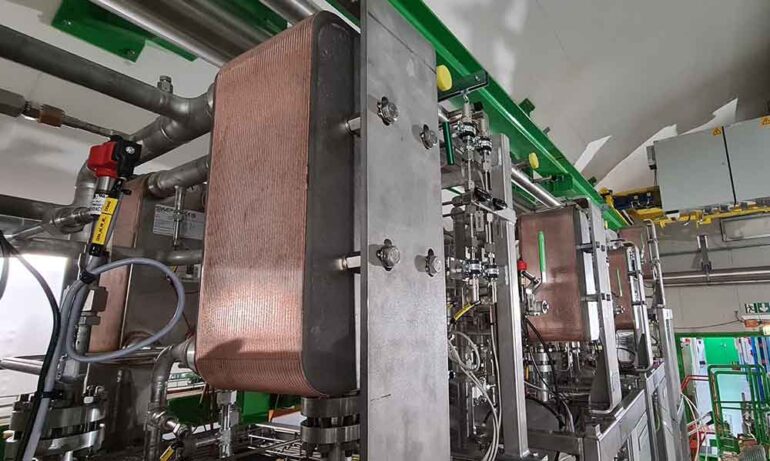
SWITZERLAND/FRANCE: Swedish manufacturer SWEP has supplied multiple brazed-plate heat exchangers for critical cooling roles at the CERN particle physics laboratory.
The heat exchangers are being deployed in the ATLAS and CMS detectors at CERN, which are currently being upgraded to make them ready for the new High-Luminosity Large Hadron Collider programme.
At 46m long, 25m high and 25m wide, the 7,000-tonne ATLAS detector is the largest volume particle detector ever constructed. It sits in a cavern 100m below ground near the main CERN site, close to the village of Meyrin in Switzerland.
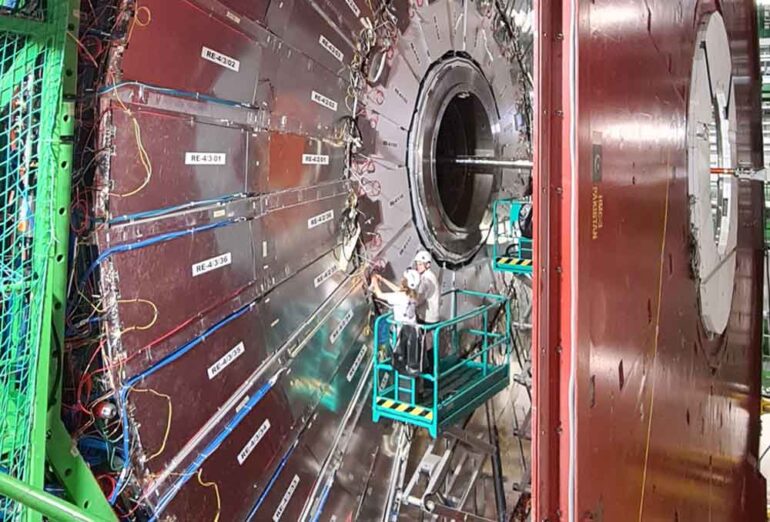
To withstand the higher levels of radiation, the upgraded detectors must be maintained below -25°C, which requires a cooling system capable of reaching temperatures as low as -40°C.
To achieve this level of cooling, the existing CO2 system, installed in the early 2000s, had to be upscaled by two orders of magnitude. An increase of this size demanded an extremely effective, large heat exchanger, positioned as a CO2 evaporator.
SWEP developed the Q185H brazed plate heat exchanger (BPHE), by updating its existing B185 BPHE with the inclusion of a Q-pipe distribution device.
Working in close collaboration with CERN engineers, these new SWEP Q185H units were adapted to meet the specific technical requirements of the new cooling system. The entire installation has been optimised to cool CO2 to -53°C – close to the temperature where it solidifies – and was dimensioned and built specifically to incorporate these units.
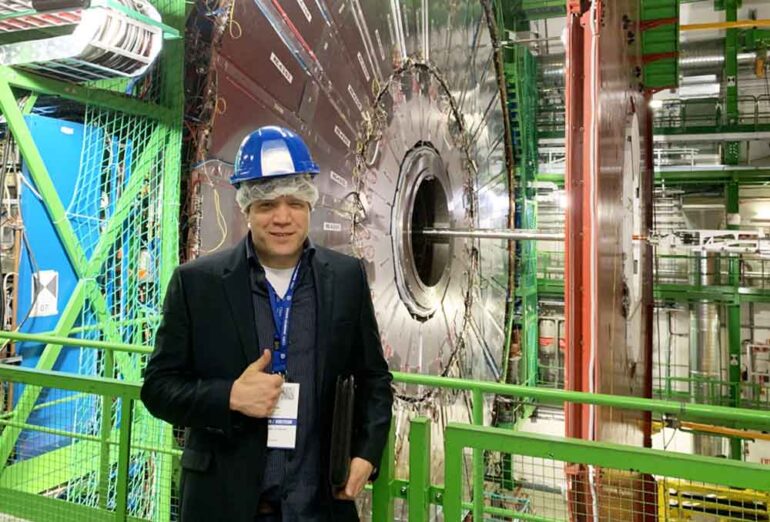
Altogether SWEP supplied 136 large-size heat exchangers – 72 B185 (without Q-Pipe) and 64 Q185 (including Q-Pipe). Different versions of the heat exchangers were supplied, with the largest Q185Hx84 having a mass of 48kg.
Ultimately, both BPHE types play critical roles as CO2 superheaters and CO2 cascades in the cooling system.
The unique properties of CO2 enable the use of small pipes – a significant advantage where space is limited. The space available underground at CERN is insufficient to house both a primary refrigeration system and an oil-free CO2 compression system.
Utilizing CO2 for primary refrigeration, however, has made it possible to install the systems above ground, far from both the detectors and the tight underground space.
Collaborations
SWEP and CERN has a long-standing collaboration in the development of high-pressure heat exchangers. SWEP’s first high-pressure heat exchanger was developed for LHCb CO2 cooling in 2005. This led to the development of the B16DW, reinforced heat exchanger, the first high-pressure model SWEP placed on the market.
The installation of low-GWP CO2 systems is a major step toward CERN achieving its environmental goals. The introduction of CO2 for detectors and other refrigeration has led to a significant reduction in greenhouse gases. Multiple systems are also under construction that will replace the present generation of gaseous detectors, which have a limited rate capability, with GEM-based detectors that use CO2 .
The new CMS and ATLAS detector cooling systems are planned to be in operation from 2030 until 2045. As of 2025, the nine next-generation CO2 cooling plants have been installed in the underground service cavern of the CMS experiment in Cessy, France.