


Solving superheat hunting in TEVs
9th August 2017 A common problem facing refrigeration and air conditioning service technicians and contractors is that of superheat hunting by thermostatic expansion valves. In this article Glen Steinkoenig (right), product manager, thermostatic expansion valves, Sporlan Division of Parker Hannifin provides a better understanding of a commonly overlooked cause of superheat hunting and how the problem might be corrected.
Definition
Superheat hunting is a cyclical fluctuation in suction superheat due to a varying refrigerant flow rate in the system. Superheat hunting is the result of the expansion valve excessively opening and closing in an attempt to maintain a constant operating condition. Hunting can be observed as regular fluctuations in suction temperature, and in extremes, suction pressure. Excessive hunting can reduce the capacity and efficiency of the system resulting in uncomfortable conditions, loss of product, and wasted energy.
Common reasons for TEV hunting
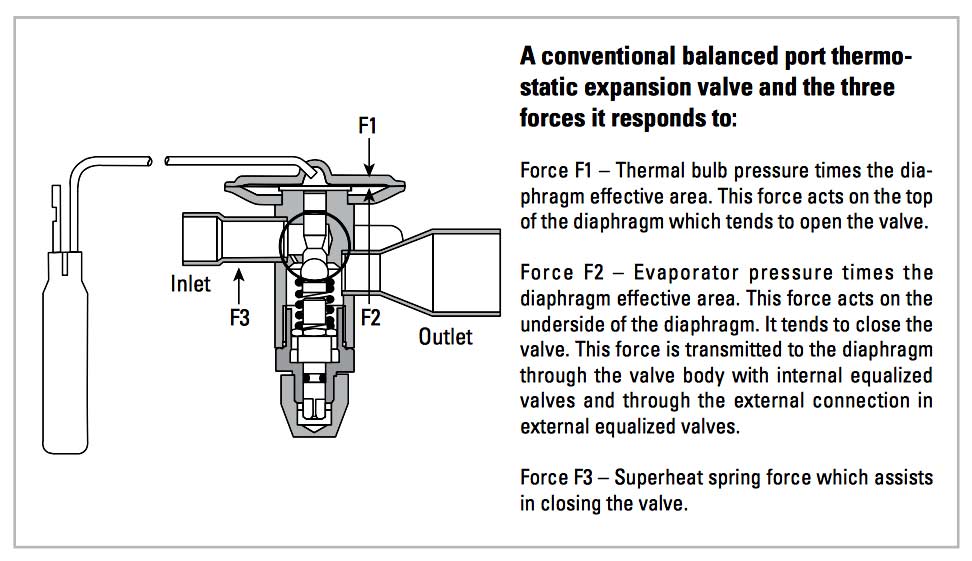
Oversized valve: The expansion valve may be oversized for the application or operating condition of the system. If the valve capacity significantly exceeds the requirements of the system, when the valve attempts to adjust to system load it overcompensates because it is oversized.
Incorrect charge selection: The charge selected does not have the necessary control characteristics and/or the dampening ability to stabilise operation.
Undercharged system: Intermittent loss of subcooling is causing loss of expansion valve capacity and resulting intermittent high superheat.
Poor bulb contact: Loss or delay of temperature signal to bulb causes erratic and unpredictable operation.
An imbalanced heat exchanger (multi-circuit coil): An imbalance in the heat load on each circuit creates a false temperature signal to the expansion valve bulb and results in erratic operation. Since this problem is commonly overlooked in the field, a closer examination and a possible solution are in order.
Balanced or unbalanced circuits?
TEVs respond, in part, to the temperature of the suction line. At the expansion valve outlet, flow is divided into two or more paths (circuits) at the inlet of the evaporator by the distributor. These paths recombine as they exit the evaporator into the suction header.
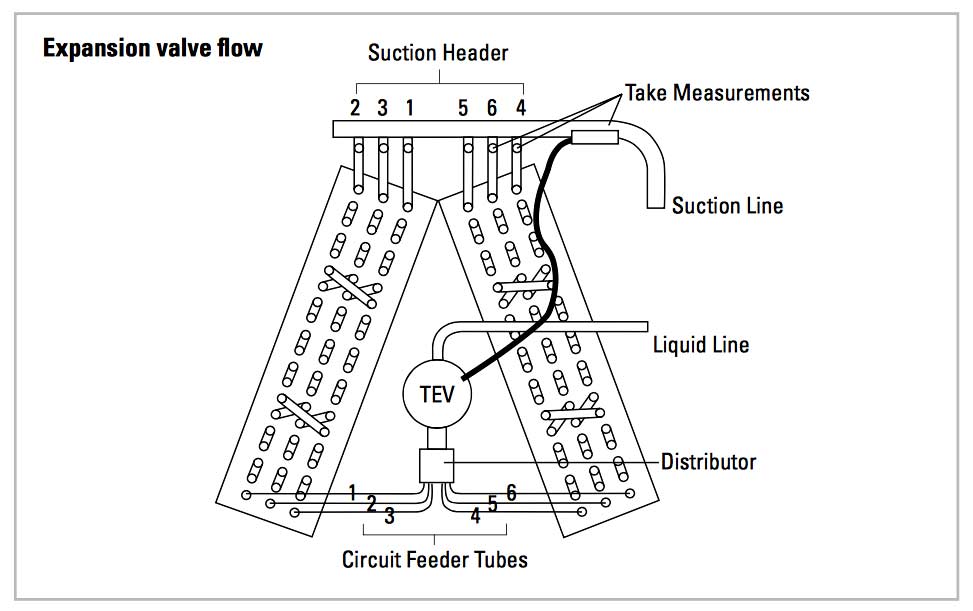
Ideally, each circuit is equally loaded and absorbs an equivalent amount of heat. If one assumes the refrigerant flow rate and heat load through each circuit is equal, then the superheat condition exiting each circuit will be equal and when all of the flow streams recombine, the result is a “true” average condition of the evaporator suction gas. When one or more circuits have a lighter heat load, some refrigerant from that circuit remains unevaporated when it exits the coil. The suction temperature where the bulb is mounted will then be lower than the “true” average of the circuits if they were all properly superheated.
Sensing a low superheat condition will cause the valve to close down because it is sensing a condition which is not superheated enough; when the valve closes down, it restricts flow to all circuits and eventually dries out the circuits which are flooding. By this time, the remaining circuits have become highly superheated due to the reduced flow rate. At the point the “flooding” circuit(s) begin to be superheated, the suction temperature rises rapidly because there is no more liquid present to falsely reduce the suction temperature.
Sensing a now high superheat condition, the valve opens to decrease superheat and the lightly loaded circuit begins to flood into the suction manifold again. Suction temperature drops rapidly again, the valve closes down again, the sequence repeating in a cyclical fashion.
Again, the ideal situation is to assume each circuit is equally loaded and absorbs an equivalent amount of heat; in reality, this situation does not always occur. There are several reasons why circuits can become unevenly loaded:
Poor heat exchanger design: In this case, each circuit is not of equal length and loading.
Poor refrigerant distribution: This problem occurs due to the wrong choice of distributor or feeder tubes, partially blocked passageways of feeder tubes, unequal feeder tube lengths, and/or kinked feeder tubes.
Uneven air flow: Air flow across the evaporator is reduced in some areas while increased in other areas. Dirty coils or damaged coil fins can have a similar effect on air flow.
Diagnosing a hunting problem: Is it the heat exchanger?
Diagnosing a hunting problem due to an imbalanced heat exchanger requires measuring the exit temperature of each circuit upstream of the suction manifold. To perform this process, average the temperatures of all of the circuits upstream of the suction manifold and compare this average temperature to the actual temperature of the suction manifold close to where the bulb is mounted. If the average value of the circuit exit temperatures exceeds the actual suction temperature value by more than 2°F, then there is likely one or more circuit(s) which are not completely superheated (flooding). A closer examination of the individual circuit temperatures and the associated suction pressure should reveal which circuit(s) are causing the problem.
One simple rule to remember is that the valve’s response will favour the circuit that is flooding. Because of this favourable response, a heat exchanger can be operating at a reasonable exit superheat but still have a significant loss in capacity because the expansion valve is responding to one or more flooding circuits while the other circuits remain highly superheated, and thus highly inefficient.
Correcting the problem
Correcting the problem can be a difficult task. First, the service tech must recognise the cause of the problem. If not, the problem can only be compensated for and this could mean a reduction in system performance. Here are some tips for correcting or compensating for an imbalanced heat exchanger:
If possible, examine and correct any problems with air flow, coil circuitry, and distribution such that the circuits are more evenly fed and loaded. The goal is a more consistent circuit exit temperature on all circuits. One lightly loaded circuit may be tolerable if there are, for example, eight circuits. However, this is probably not the case if there are only three.
Adjust the superheat of the valve to a slightly higher value. Attempting to control an evaporator near to or lower than 5°F operating superheat can exceed the sensing capability of most expansion valves and result in hunting and subsequent intermittent flooding.
If practical, move the bulb farther downstream on the suction line. Better mixing of the refrigerant prior to the bulb can “smooth” out the valve response although capacity and efficiency may not improve significantly.
For further details, download the Parker Hannifin catalogue E-1a TEV & AEV Theory and Application.
This article – HVACR Tech Tip: Understanding and Preventing Superheat Hunting in TEVs – is reproduced with permission from the Parker website.