


Cool wall shows 8% savings
4th September 2021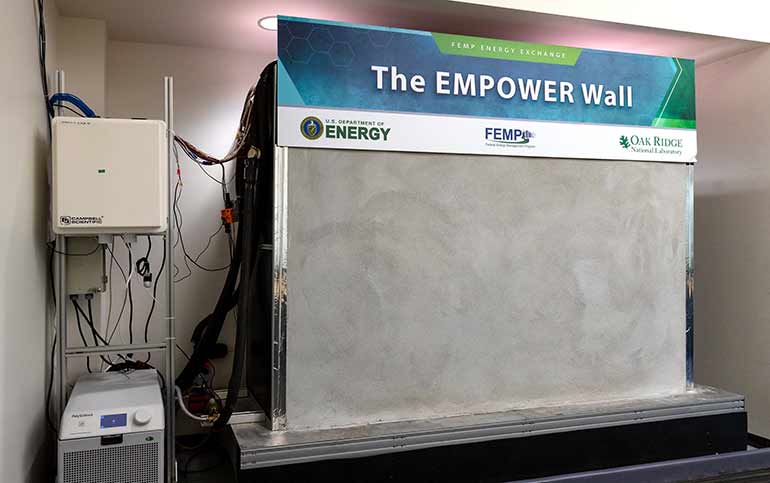
USA: Tests on a 3D printed concrete smart wall cooling system has shown energy savings of 8%, with the potential for higher savings.
The Empower wall achieved the savings during a three-month field test at the Department of Energy’s manufacturing demonstration facility at the Oak Ridge National Laboratory (ORNL).
Data from the 5ft x 8ft (1.5m x 2.4m) wall was used with predictive modelling to estimate performance in the Southeastern United States climate zone during summer months. The modelling is said to have indicated a full deployment would show savings of 8% with the potential to go higher.
The Empower wall is embedded with pipes that carry chilled water to lower its temperature. The wall transfers coolness stored within to the occupied space when needed. Data gathered included energy efficiency, costs, resilience and overall performance in reducing electricity demand without compromising the occupant’s comfort.
“Preliminary analysis shows this prototype wall has a potential to save energy and reduce peak demand,” ORNL’s Piljae Im said. “Future modelling analysis will include increasing the wall’s cooling capacity and analysing savings potential in different climate zones.”
The wall was 3D-printed at ORNL using an infrastructure scale additive manufacturing system called SkyBAAM that prints concrete.
The Empower wall contains thermal storage and active insulation systems. The embedded pipes carry chilled water throughout the wall during low peak demand hours, cooling the interior temperature of the wall.
Active insulation surrounding the thermal storage can vary its thermal conductivity on demand. It transfers the coolness stored in the interior of the wall to the occupied space when needed. In the winter, the temperature of the wall is raised above the indoor space and heat is released.
The on-demand capabilities of the active insulation reduce electricity costs by lowering the use of the HVAC system during peak demand hours or when costs are high. This ability to tailor the HVAC’s operation provides flexibility.
The chiller and pumps employ a smart inverter connected to a battery that also stores energy from the building’s main power grid during low electricity demand times and allows the energy to be available when needed during peak demand times.
The inverter also enables the wall to use renewable energy systems such as solar, fuel cells, and wind turbines.
Related stories:
ORNL produces 3D-printed cooling smart wall – 23 August 2020
USA: A leading US laboratory has demonstrated a first of its kind 3D-printed concrete smart wall cooling system. Read more…