



Industry scorns new R1234yf toxicity claims
9th April 2014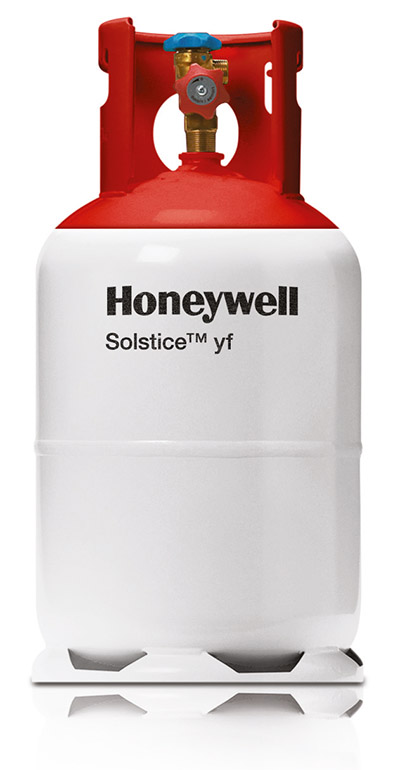 USA and GERMANY: The bickering over R1234yf continues with German chemists making new toxicity claims and US engineers and Honeywell reaffirming its safety.
While the rest of the world has seemingly accepted R1234yf as the low GWP replacement for R134a in car air conditioning systems, Germany stands alone questioning the safety of this new refrigerant, despite thousands of cars already operating with the refrigerant on German roads.
With Germany facing EU fines for allowing Daimler to shun the new gas on safety grounds, chemists at Ludwig Maximilians University (LMU) in Munich now claim that in the event of a fire highly toxic carbonyl fluoride is released. Previous German studies have questioned the flammability of R1234yf and the potential release of toxic hydrogen fluoride.
“With our analysis, we can now demonstrate that 20% of the fire gases consist of the even more toxic carbonyl fluoride,” commented Andreas Kornath, professor of inorganic chemistry at the LMU Munich.
Refrigerant manufacturer Honeywell was quick to pour scorn on the latest claims: “Contrary to the misleading and clearly biased assertions of the report’s authors, carbonyl fluoride (COF2) is in fact a well-known breakdown product of HFO1234yf that has been publicly studied by leading experts in the automotive industry,” said a spokesman.
“It was studied in the 2007-2009 Cooperative Research Program (CRP) conducted by SAE International, the world’s leading automotive engineering organisation. The SAE CRP reviewed the COF2 data, included it in its risk assessment, and concluded that HFO1234yf is safe for use in automotive air conditioning. In March, the EU’s Joint Research Centre also reviewed this data and again concluded that HFO1234yf is safe for use in automobile air conditioning.
COF2 is also formed during the burning of the current automotive refrigerant HFC134a, used in hundreds of millions of vehicles worldwide today. When COF2 does form in such conditions, it only lasts for a fraction of a second, which is not long enough to put bystanders, passengers, or first responders in any danger.”
Meanwhile, the Society of Automotive Engineers has backed the findings of its most recent Cooperative Research Team findings that R1234yf is safe with the publication of a new evaluation methodology.
Earlier this year, the cooperative research team (SAE CRP1234-4) concluded “risks are still very small compared to the risks of a vehicle fire from all causes and well below risks that are commonly viewed as acceptable by the general public.”
Developed for assessing the suitability of R1234yf in vehicles, the new methodology relates primarily to evaluating the flammability of the refrigerant in the engine compartment during a frontal collision.
The specific types of analysis included in the methodology are: exhaust-system thermal characterisation, computer simulated crash tests, actual crash tests, teardown and examination of crashed parts, and releases of refrigerant onto hot exhaust manifolds. Each type of analysis was logically ordered and combined to produce a comprehensive evaluation methodology.
This methodology has been applied and demonstrates that R1234yf is difficult to ignite when factors that occur in frontal crashes are simultaneously considered, says the SAE. Factors considered in this analysis include: crush and deformation of the vehicle structure, airflow in the engine compartment, exhaust system temperatures during different driving scenarios, and coolant release due to damage of the engine coolant system.